
10 Common Mistakes Beginners Make When Learning OpenFOAM
Blog post description.
ARTICLES
Wiratama
3/7/20263 min read
Learning OpenFOAM can be an exciting step for engineers and researchers interested in computational fluid dynamics. As one of the most powerful open-source CFD platforms, OpenFOAM offers flexibility, transparency, and full control over numerical models. However, beginners often face a steep learning curve because the software requires an understanding of both CFD fundamentals and its unique case structure. Many newcomers repeat the same mistakes during their early learning phase, which can slow down progress and create frustration.
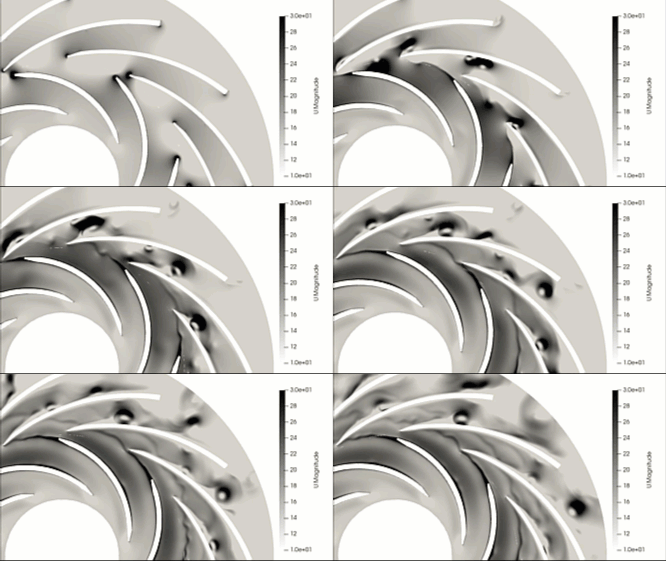
One of the most common mistakes beginners make is focusing too much on running simulations rather than understanding the physics behind them. Many new users try to replicate tutorials or copy case files without carefully studying the governing equations, boundary conditions, and assumptions behind the model. Without understanding the physical meaning of the simulation, it becomes difficult to detect errors or interpret the results correctly.
Another frequent mistake is neglecting mesh quality. In CFD, the mesh plays a critical role in determining the accuracy and stability of the solution. Beginners often generate meshes quickly without checking key parameters such as skewness, non-orthogonality, aspect ratio, and cell size distribution. Poor mesh quality can lead to numerical instability, divergence, or inaccurate results, even if the solver setup appears correct.
Improper boundary condition selection is also a common issue. Many beginners assign boundary conditions simply because they appear in a tutorial rather than because they represent the physical problem correctly. For example, using a fixedValue boundary condition when a pressure outlet would be more appropriate can produce unrealistic flow behavior. Understanding the meaning of each boundary condition is essential for building reliable simulations.
Another mistake is choosing the wrong solver for the problem. OpenFOAM contains many different solvers designed for specific types of flows, such as incompressible, compressible, multiphase, or reacting flows. Beginners sometimes attempt to solve problems using solvers that are not suitable for the physics being modeled. Selecting the appropriate solver requires understanding the flow regime, turbulence model requirements, and numerical formulation.
Many beginners also overlook the importance of timestep selection and numerical stability. When using transient solvers, the timestep must be chosen carefully to satisfy the Courant–Friedrichs–Lewy (CFL) condition. If the timestep is too large, the simulation may diverge or produce unrealistic oscillations. New users often underestimate how critical this parameter is to obtaining stable and meaningful results.
Another common mistake is ignoring solver residuals and convergence behavior. Some beginners assume that once a simulation finishes running, the results are automatically correct. However, monitoring residuals and checking whether the solution has converged is an essential part of CFD analysis. Without convergence verification, the simulation results may not represent a physically meaningful solution.
Beginners also often neglect post-processing and result validation. Running the solver is only part of the CFD workflow. It is equally important to analyze velocity fields, pressure distributions, and other variables to determine whether the results make physical sense. Comparing simulation outcomes with analytical solutions, experimental data, or theoretical expectations is a crucial step that many new users skip.
Another mistake is modifying too many parameters at once. When simulations fail or produce unexpected results, beginners sometimes change multiple settings simultaneously, including turbulence models, discretization schemes, solver tolerances, and boundary conditions. This makes it difficult to identify which parameter caused the problem. A better approach is to modify one variable at a time while carefully observing its effect on the solution.
Many beginners also underestimate the importance of reading log files. OpenFOAM produces detailed output during simulation runs, including warnings, solver performance information, and residual histories. These log files often contain valuable clues when something goes wrong. Ignoring them means missing important information that could help diagnose errors.
Finally, a common mistake is expecting OpenFOAM to behave like commercial CFD software with graphical interfaces. Unlike many commercial packages, OpenFOAM is primarily driven by text-based configuration files and command-line tools. Beginners who rely heavily on graphical tools may struggle to understand how cases are structured internally. Taking the time to learn the directory structure, dictionary files, and command-line utilities is essential for becoming proficient with OpenFOAM.
Learning OpenFOAM requires patience, curiosity, and a willingness to explore both the numerical methods and the physical modeling aspects of CFD. While beginners often encounter these common mistakes, recognizing them early can significantly accelerate the learning process. By focusing on fundamentals, understanding the simulation setup, and carefully validating results, new users can build a strong foundation for using OpenFOAM effectively in research and engineering applications.
cfdcourse.com
Contact
wiratama@pttensor.com
+62-821-3868-4162
© 2026. All rights reserved.