
5 Engineering Problems That CFD Simulation Can Solve
Blog post description.
ARTICLES
Wiratama
3/8/20262 min read
Computational fluid dynamics (CFD) has become an essential tool in modern engineering because many systems involve fluid flow, heat transfer, or gas movement that cannot be easily predicted with simple equations alone. By simulating these physical processes in a virtual environment, engineers can analyze complex behaviors before building prototypes or performing expensive experiments. CFD is widely used across industries such as aerospace, automotive, energy, and manufacturing to solve a variety of engineering problems.
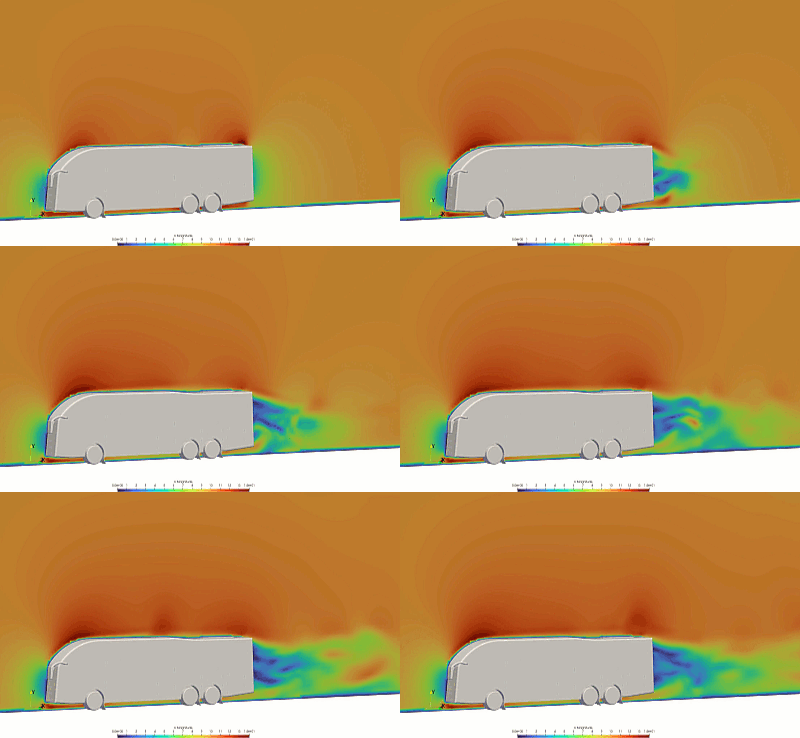
One common engineering problem that CFD can solve is aerodynamic performance analysis. Engineers designing aircraft, automobiles, drones, or wind turbines must understand how air flows around these objects. Poor aerodynamic design can increase drag, reduce efficiency, and create instability at high speeds. CFD simulations allow engineers to visualize airflow patterns, pressure distributions, and wake structures around a body. With this information, designers can modify shapes to reduce drag, improve lift characteristics, and enhance overall performance.
Another important application of CFD is thermal management. Many engineering systems generate heat during operation, and controlling that heat is essential for reliability and performance. Electronic devices, data centers, power systems, and industrial machinery all require effective cooling strategies. CFD simulations allow engineers to analyze temperature distribution, airflow paths, and heat transfer rates within these systems. By understanding where heat accumulates and how air circulates, engineers can design better cooling systems and prevent overheating.
CFD is also widely used to analyze fluid flow inside pipes, ducts, and channels. Industrial systems such as pipelines, HVAC systems, and water distribution networks rely on controlled fluid transport. Engineers must understand pressure losses, flow distribution, and potential turbulence inside these systems. CFD simulations can predict pressure drops, identify areas of recirculation or flow separation, and help optimize the layout of piping systems. This allows engineers to design more efficient fluid transport systems and reduce energy consumption.
Mixing and chemical reaction processes are another area where CFD plays an important role. Many industrial processes involve mixing fluids, gases, or chemicals in reactors, tanks, or processing equipment. The effectiveness of mixing directly affects reaction rates, product quality, and system efficiency. CFD simulations allow engineers to study how fluids interact inside mixing devices, evaluate turbulence levels, and determine how quickly substances combine. By analyzing these flow patterns, engineers can optimize mixer designs and improve process performance.
Another engineering problem that CFD can address is environmental flow analysis. Engineers often need to understand how air or water moves through natural or built environments. Examples include studying wind flow around buildings, pollutant dispersion in urban areas, or water currents in rivers and coastal regions. CFD simulations allow engineers to predict how environmental flows behave under different conditions. This information can support urban planning, environmental protection, and infrastructure design.
In addition to these examples, CFD is used in many other engineering applications such as combustion modeling, pump and turbine design, biomedical flow analysis, and energy system optimization. The ability to simulate complex fluid behavior provides engineers with valuable insight into systems that are difficult to analyze experimentally.
Ultimately, CFD simulation helps engineers understand physical phenomena that influence the performance and safety of engineering systems. By solving problems related to aerodynamics, heat transfer, fluid transport, mixing processes, and environmental flows, CFD allows engineers to design more efficient, reliable, and innovative technologies.
cfdcourse.com
Contact
wiratama@pttensor.com
+62-821-3868-4162
© 2026. All rights reserved.