
5 Essential Turbulence Models Every OpenFOAM User Must Understand
Blog post description.
ARTICLES
Wiratama
3/7/20263 min read
Turbulence modeling is one of the most important aspects of computational fluid dynamics. Most real engineering flows are turbulent, which means the fluid motion contains complex fluctuations in velocity and pressure across many spatial and temporal scales. Directly resolving all turbulent scales requires extremely fine meshes and enormous computational resources, which is why turbulence models are commonly used. In OpenFOAM, several turbulence models are available, each designed to approximate the effects of turbulence in different types of flow problems. Understanding the most commonly used models is essential for anyone performing CFD simulations.
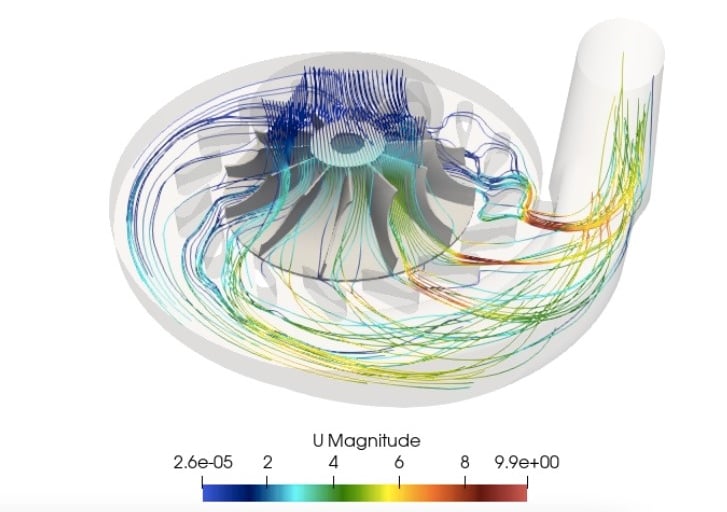
One of the most widely used turbulence models is the k-epsilon model. This model is based on two transport equations: one for turbulent kinetic energy and another for the rate of dissipation of that energy. The k-epsilon model is known for its robustness and computational efficiency, which makes it suitable for many industrial applications such as internal flows, pipe flows, and ventilation systems. Because it is relatively stable and easy to converge, it is often one of the first turbulence models that beginners learn when working with OpenFOAM. However, it may not perform well in flows with strong separation or strong curvature effects.
Another commonly used model is the k-omega model. Like the k-epsilon model, it uses two transport equations, but instead of dissipation rate it solves for the specific dissipation rate. The k-omega formulation tends to perform better near walls, which makes it useful for boundary layer flows and applications where wall effects are important. It can provide improved accuracy in certain aerodynamic and turbomachinery simulations compared with the standard k-epsilon model.
The k-omega SST model is one of the most popular turbulence models in modern CFD simulations. The SST formulation combines the advantages of both the k-epsilon and k-omega models. Near the wall, it behaves like the k-omega model to better capture boundary layer behavior. In the outer flow region, it transitions toward the k-epsilon model to improve stability. Because of this hybrid behavior, the SST model performs well in flows with separation, adverse pressure gradients, and complex aerodynamic features. It is widely used in simulations involving aircraft, wind turbines, and external aerodynamic flows.
Another important turbulence modeling approach is Large Eddy Simulation. Instead of modeling all turbulent scales, this approach directly resolves the larger eddies in the flow while modeling only the smaller subgrid-scale turbulence structures. Large Eddy Simulation can produce more detailed and physically realistic turbulence structures compared with traditional Reynolds-averaged turbulence models. However, it requires significantly finer meshes and smaller timesteps, which makes it computationally expensive. In OpenFOAM, Large Eddy Simulation is often used in research applications where capturing transient turbulent structures is important.
Detached Eddy Simulation is another hybrid approach that combines features of Reynolds-averaged turbulence modeling and Large Eddy Simulation. In this method, the flow near solid boundaries is modeled using traditional turbulence models, while the separated flow regions away from walls are simulated using Large Eddy Simulation techniques. This approach provides better accuracy than simple Reynolds-averaged models in flows with large separations while reducing computational cost compared with full Large Eddy Simulation.
Choosing the correct turbulence model depends on the physics of the problem, computational resources, and the level of accuracy required. For many industrial applications, Reynolds-averaged models such as k-epsilon or k-omega SST provide a good balance between accuracy and computational cost. More advanced models such as Large Eddy Simulation are typically used when detailed turbulence structures must be resolved.
For OpenFOAM users, understanding the strengths and limitations of these turbulence models is essential for producing reliable simulations. Selecting an appropriate model helps ensure that the simulation captures the key physical behavior of the flow without requiring unnecessary computational expense. As users gain more experience, they often learn to evaluate different turbulence models and compare their predictions to determine which approach best represents the problem being studied.
cfdcourse.com
Contact
wiratama@pttensor.com
+62-821-3868-4162
© 2026. All rights reserved.