
Can OpenFOAM Replace ANSYS Fluent for Industrial CFD?
Blog post description.
ARTICLES
Wiratama
3/7/20263 min read
Computational fluid dynamics engineers often ask whether OpenFOAM can replace ANSYS Fluent for industrial CFD applications. Both tools are powerful simulation platforms capable of solving complex fluid flow and heat transfer problems. However, they are built on different philosophies. Fluent is a commercial software developed with an integrated graphical workflow and professional support, while OpenFOAM is an open-source framework that emphasizes flexibility and customization. Because of these differences, the answer to whether OpenFOAM can replace Fluent depends on the specific needs of a company or engineering project.
OpenFOAM has gained significant attention in recent years because it offers capabilities comparable to many commercial CFD packages while remaining completely open source. Engineers can download, modify, and run OpenFOAM without paying licensing fees. This makes it especially attractive for organizations that perform large numbers of simulations or rely heavily on high-performance computing resources. In many industrial simulations, computational cost is not only determined by hardware but also by software licensing. OpenFOAM removes these restrictions, allowing engineers to use as many processors as their hardware supports.
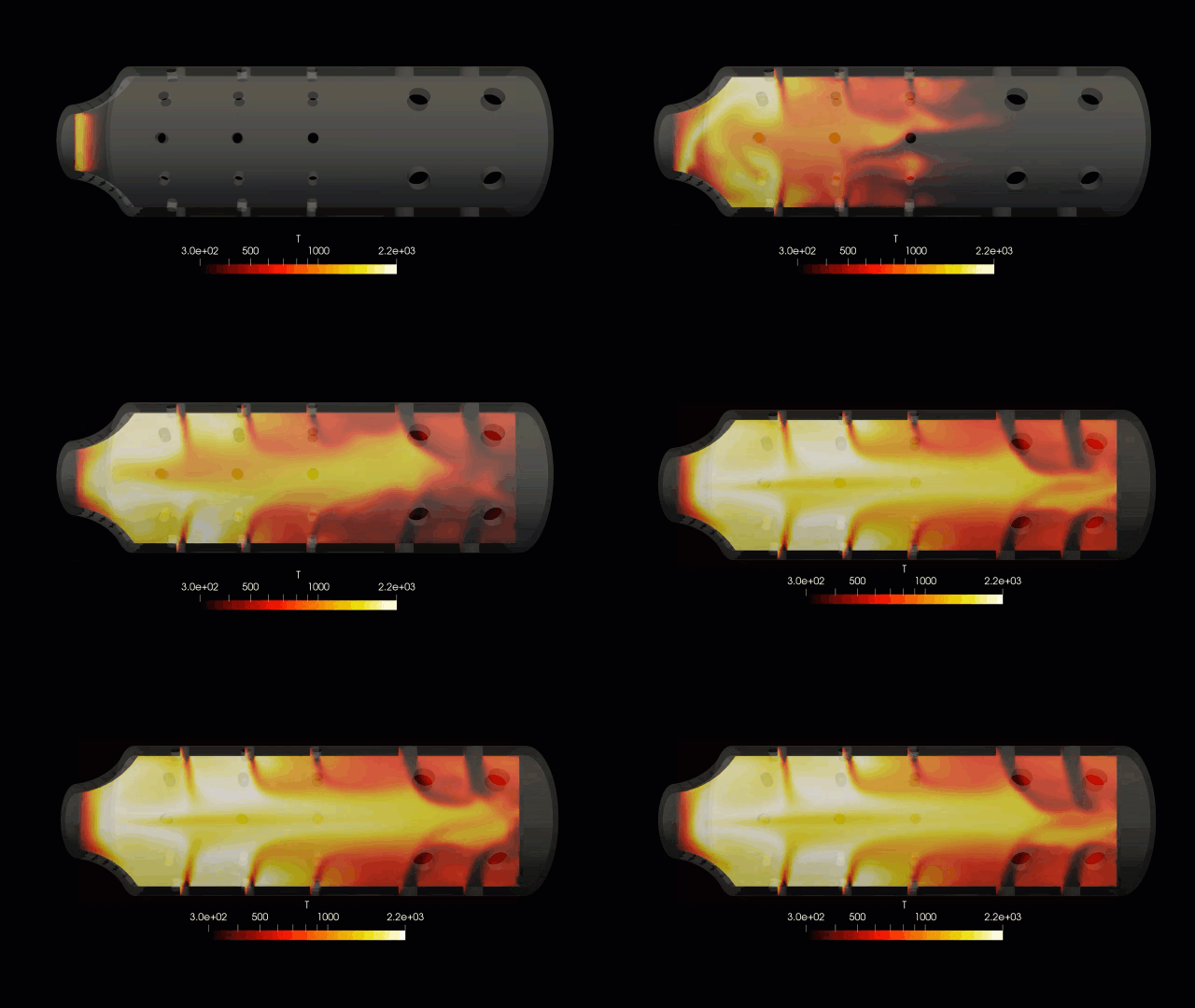
Another major advantage of OpenFOAM is its flexibility. Because the source code is fully accessible, engineers can modify existing solvers, implement new physical models, or develop entirely new simulation tools. This level of customization is particularly useful in research and development environments where standard CFD models may not capture all the physical phenomena involved in a project. In contrast, commercial CFD software typically limits direct modification of the solver algorithms, although some customization may be possible through scripting interfaces or user-defined functions.
OpenFOAM is also well suited for large-scale simulations on high-performance computing clusters. Many industrial problems involve extremely large meshes and complex physical models that require significant computational power. Without licensing restrictions tied to processor usage, OpenFOAM allows engineers to run simulations on hundreds or even thousands of CPU cores. For organizations working with large CFD models, this can result in substantial cost savings compared with commercial software that charges additional fees for parallel computing capabilities.
Despite these advantages, ANSYS Fluent still holds an important position in industrial CFD workflows. One of its main strengths is the integrated graphical interface that guides users through each stage of the simulation process. Engineers can create geometry, generate meshes, define physical models, run simulations, and visualize results within a unified environment. This workflow reduces the complexity of simulation setup and allows engineers to perform analyses more quickly, particularly for routine industrial problems.
Another advantage of Fluent is its mature ecosystem. The software has been widely used in industry for many years, which means it includes extensive documentation, validated models, and professional technical support. Many companies rely on Fluent not only for simulation capability but also for the reliability and consistency of its results. When simulations are used to support product development or safety decisions, having access to professional support and validated workflows can be an important factor.
Ease of use is another area where Fluent often has an advantage. Because OpenFOAM relies heavily on command-line operations and text-based configuration files, beginners may find it more difficult to learn. Engineers must understand the structure of case directories, configuration dictionaries, and numerical settings before they can build reliable simulations. While this approach provides greater flexibility, it also requires a deeper technical understanding of both CFD and the software environment.
Accuracy is often a concern when comparing OpenFOAM with commercial CFD software. In practice, both platforms are capable of producing accurate results when simulations are properly configured. Many turbulence models, multiphase models, and heat transfer models available in commercial software also exist in OpenFOAM. Studies comparing simulations performed using OpenFOAM and Fluent have shown that the results can be very similar when the same models, meshes, and boundary conditions are used. This indicates that the quality of a CFD simulation often depends more on the engineer’s modeling decisions than on the specific software platform.
In many industrial environments, OpenFOAM is not used as a direct replacement for Fluent but rather as a complementary tool. Companies may use Fluent for routine engineering analyses because of its user-friendly workflow and integrated tools. At the same time, OpenFOAM may be used for specialized research problems, advanced modeling tasks, or simulations that require extensive customization. By combining both tools, engineers can benefit from the strengths of each platform.
Another reason OpenFOAM continues to grow in popularity is its strong academic presence. Many universities use OpenFOAM in research and graduate-level CFD courses because it allows students to explore the underlying numerical methods and solver algorithms. As more engineers graduate with experience in OpenFOAM, the software naturally becomes more common in industrial environments as well.
Ultimately, whether OpenFOAM can replace ANSYS Fluent depends on the specific context of the engineering problem. For organizations that require maximum flexibility, large-scale computing, and the ability to customize numerical models, OpenFOAM can be a powerful alternative. For companies that prioritize ease of use, integrated workflows, and professional support, Fluent may remain the preferred tool.
In practice, the most effective approach for many CFD engineers is to become familiar with both platforms. Understanding how to work with both OpenFOAM and commercial CFD software provides greater versatility and allows engineers to choose the most appropriate tool for each project. As simulation technology continues to evolve, the ability to adapt between different CFD environments will remain an important skill in modern engineering practice.
cfdcourse.com
Contact
wiratama@pttensor.com
+62-821-3868-4162
© 2026. All rights reserved.