
CFD Simulation for Building Ventilation Design
Blog post description.
ARTICLES
Wiratama
3/8/20263 min read
Building ventilation design plays an important role in maintaining indoor air quality, thermal comfort, and energy efficiency. Modern buildings such as offices, hospitals, factories, and commercial centers require carefully designed ventilation systems to ensure that fresh air is distributed properly while contaminants and excess heat are removed effectively. Designing these systems can be challenging because airflow inside buildings interacts with walls, furniture, equipment, and occupants in complex ways. Computational fluid dynamics (CFD) simulation has become a powerful tool for analyzing these airflow patterns before construction or system installation begins.
CFD simulation allows engineers to create a virtual model of a building or indoor space and analyze how air moves through the environment. By solving the governing equations of fluid motion, CFD can predict airflow velocity, pressure distribution, and temperature fields throughout the space. This information helps engineers understand whether the ventilation system provides sufficient airflow and whether the air is distributed evenly throughout the room or building.
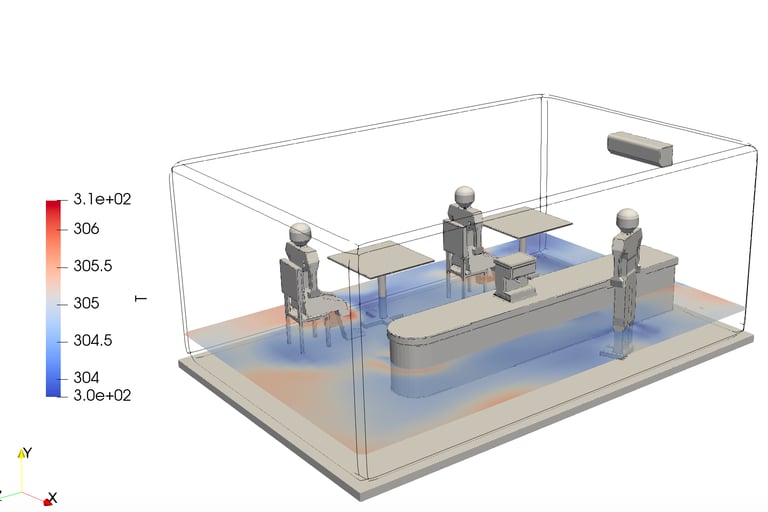
One of the main advantages of CFD simulation in building ventilation design is the ability to visualize airflow patterns. In many ventilation systems, air enters through supply diffusers and leaves through return vents. If these components are not placed correctly, airflow may bypass certain areas, creating regions with poor ventilation. CFD simulations allow engineers to observe how air travels through the space and identify areas where airflow is weak or stagnant. These insights allow designers to modify diffuser locations, airflow rates, or duct configurations to achieve better ventilation performance.
Temperature distribution is another critical factor in ventilation design. Buildings often contain multiple heat sources, including occupants, electronic equipment, lighting systems, and solar radiation through windows. These heat sources influence how air moves and how temperature spreads throughout the space. CFD simulations allow engineers to analyze temperature gradients and evaluate whether the ventilation system can maintain comfortable thermal conditions. By studying these temperature patterns, designers can adjust airflow strategies to improve cooling or heating efficiency.
CFD simulation is also widely used to evaluate indoor air quality. In many buildings, ventilation systems must remove contaminants such as dust, airborne particles, or chemical pollutants. CFD models can simulate how these contaminants move and disperse through indoor spaces. Engineers can use these simulations to determine whether ventilation systems effectively remove pollutants or whether certain areas experience poor air circulation. This analysis is particularly important in environments such as hospitals, laboratories, and cleanrooms where air quality is critical.
Open-source CFD software such as OpenFOAM is increasingly used in building ventilation analysis. OpenFOAM provides engineers with a flexible simulation framework that can model airflow, heat transfer, and contaminant transport inside buildings. Because OpenFOAM is open source, engineers and researchers can customize models and numerical methods to match specific ventilation problems. This flexibility makes OpenFOAM a valuable tool for studying complex indoor airflow behavior and developing optimized ventilation strategies.
Another advantage of CFD tools like OpenFOAM is their ability to analyze different ventilation scenarios quickly. Engineers can simulate multiple design alternatives, including different diffuser arrangements, airflow rates, or room layouts. By comparing simulation results, designers can identify the configuration that provides the best combination of airflow distribution, thermal comfort, and energy efficiency. This approach reduces the need for costly experimental testing and accelerates the design process.
CFD simulations are also useful for evaluating the performance of natural ventilation systems. In some buildings, airflow is driven by wind pressure and temperature differences rather than mechanical fans. Predicting how natural ventilation behaves can be difficult because it depends on external weather conditions and building geometry. CFD models allow engineers to study how wind interacts with building openings, windows, and internal spaces, helping designers create buildings that take advantage of natural airflow for cooling and ventilation.
In addition to improving comfort and air quality, CFD simulation can help reduce energy consumption in buildings. Heating, ventilation, and air conditioning systems account for a large portion of building energy use. By optimizing airflow distribution and temperature control using CFD, engineers can design ventilation systems that maintain comfortable conditions while minimizing energy demand.
Although CFD simulation provides valuable insight, it is usually used together with traditional HVAC design methods and experimental measurements. Simulation results help guide design decisions, while real-world testing helps validate system performance. When used together, these approaches allow engineers to create ventilation systems that are both efficient and reliable.
Overall, CFD simulation has become an essential tool for modern building ventilation design. By analyzing airflow patterns, temperature distribution, and contaminant transport, engineers can design ventilation systems that improve indoor air quality, maintain comfortable environments, and reduce energy consumption. Tools such as OpenFOAM provide powerful capabilities for studying these complex airflow behaviors and supporting the development of more effective ventilation solutions in modern buildings.
cfdcourse.com
Contact
wiratama@pttensor.com
+62-821-3868-4162
© 2026. All rights reserved.