
CFD Simulation for Mixing Tank Design
Blog post description.
ARTICLES
Wiratama
3/8/20263 min read
Mixing tanks are widely used in many industries such as chemical processing, pharmaceuticals, food production, and wastewater treatment. In these systems, liquids or gases must be mixed efficiently to achieve uniform concentration, proper chemical reactions, or consistent product quality. Designing an effective mixing tank can be challenging because fluid motion inside the tank is complex and influenced by factors such as impeller geometry, tank shape, baffles, and fluid properties. Computational fluid dynamics (CFD) has become an important tool for analyzing and optimizing mixing tank performance.
CFD simulation allows engineers to study the internal flow behavior inside a mixing tank in a virtual environment. By solving the governing equations of fluid motion, CFD models can predict velocity fields, turbulence levels, pressure distribution, and concentration mixing patterns. This information helps engineers understand how fluid circulates within the tank and whether the mixing process is effective.
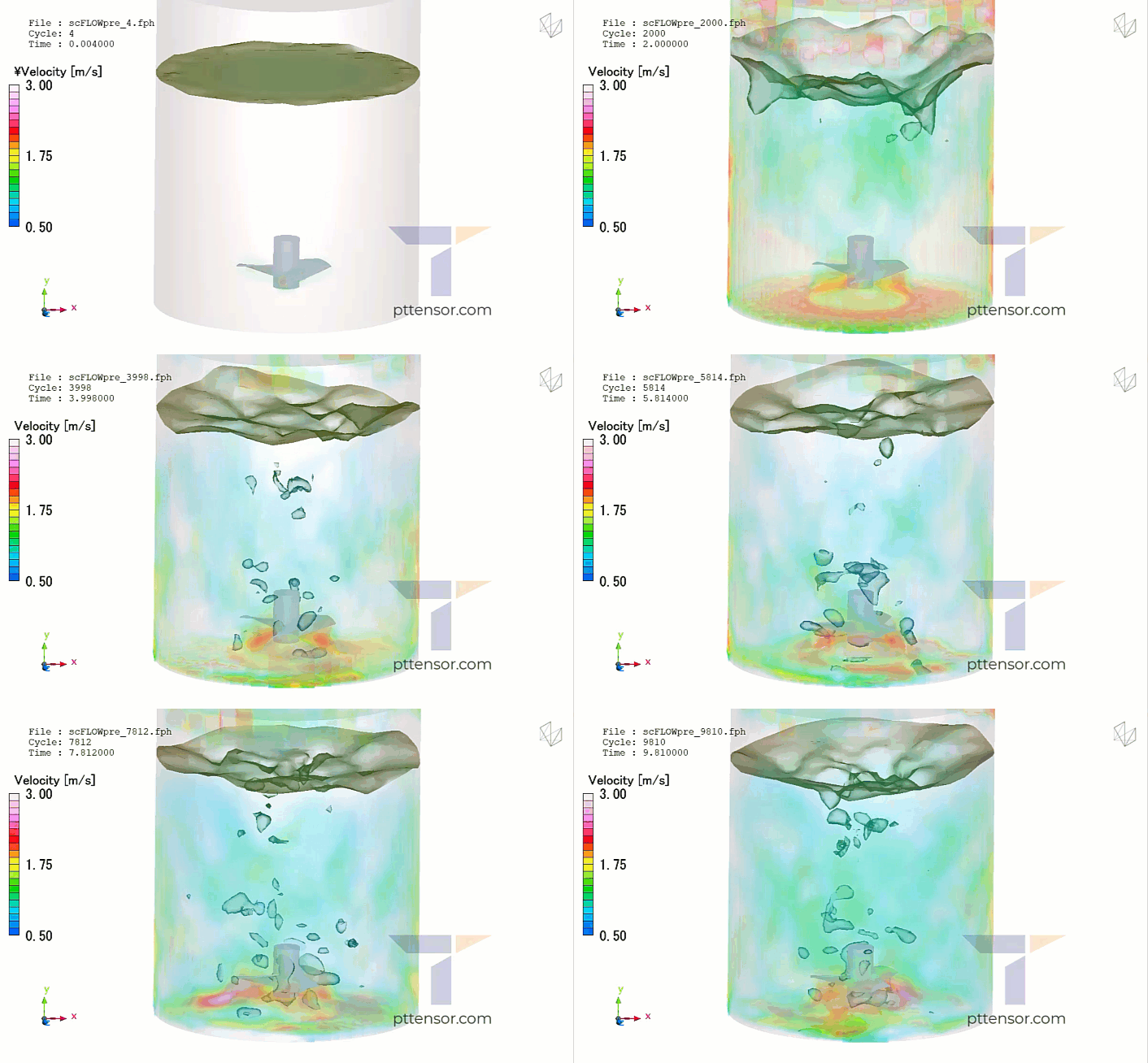
One of the main advantages of CFD in mixing tank design is the ability to visualize flow patterns generated by the rotating impeller. The impeller creates complex flow structures that drive fluid circulation throughout the tank. CFD simulations allow engineers to observe how fluid moves from the impeller region to other parts of the tank, revealing whether dead zones or poorly mixed regions exist. Identifying these areas helps designers modify impeller placement or tank geometry to improve mixing efficiency.
Another important aspect of mixing tank performance is turbulence. Turbulence enhances mixing by increasing the interaction between different fluid layers. CFD simulations allow engineers to analyze turbulence intensity and energy distribution within the tank. This information helps determine whether the chosen impeller design generates sufficient turbulence to achieve the desired mixing performance.
CFD is also valuable for studying the effect of impeller design on mixing behavior. Different impeller types, such as axial flow impellers or radial flow impellers, create different flow patterns inside the tank. Axial impellers typically promote vertical circulation, while radial impellers generate strong outward flow from the impeller blades. CFD simulations allow engineers to compare these designs and determine which configuration produces the most effective mixing for a specific process.
Baffles are another important component in mixing tank design. Baffles are vertical plates installed inside the tank to prevent fluid from simply rotating with the impeller. Without baffles, the fluid may form a swirling motion that reduces mixing efficiency. CFD simulations allow engineers to evaluate how baffles influence flow circulation and turbulence distribution within the tank. By adjusting baffle number, size, or placement, engineers can improve overall mixing performance.
CFD simulations are also useful for predicting mixing time, which is the time required for a substance added to the tank to become uniformly distributed. In many industrial processes, achieving uniform concentration quickly is essential for maintaining product quality or ensuring proper chemical reactions. CFD models can track how substances disperse throughout the tank and estimate how long it takes to reach uniform mixing conditions.
Another important factor in mixing tank operation is power consumption. The rotating impeller requires energy to generate fluid motion, and excessive power usage increases operational costs. CFD simulations allow engineers to evaluate the relationship between mixing efficiency and energy input. By optimizing impeller speed, blade geometry, and tank configuration, designers can achieve effective mixing while minimizing energy consumption.
Open-source CFD software such as OpenFOAM is increasingly used for mixing tank analysis and optimization. OpenFOAM provides flexible modeling capabilities that allow engineers to simulate rotating machinery, turbulence, multiphase flows, and chemical reactions within mixing systems. Because OpenFOAM is open source, engineers can customize models to represent specific industrial processes and study complex mixing phenomena in detail.
Another advantage of CFD is the ability to test multiple design variations before building physical equipment. Engineers can evaluate different tank sizes, impeller types, and operating conditions within a virtual environment. This approach reduces the need for costly experimental prototypes and accelerates the design process.
In practical engineering applications, CFD simulations are often combined with experimental measurements to validate results and ensure reliability. While experiments provide real-world data, CFD offers detailed visualization of flow behavior that may be difficult to measure directly. Together, these approaches allow engineers to design mixing systems that are both efficient and reliable.
Overall, CFD simulation has become a valuable tool for improving mixing tank design. By providing detailed insight into fluid flow patterns, turbulence distribution, mixing time, and energy consumption, CFD helps engineers optimize tank geometry and operating conditions. Tools such as OpenFOAM enable advanced analysis of mixing processes and support the development of more efficient industrial mixing systems.
cfdcourse.com
Contact
wiratama@pttensor.com
+62-821-3868-4162
© 2026. All rights reserved.