
CFD Simulation of Wind Flow Around Buildings
Blog post description.
ARTICLES
Wiratama
3/8/20263 min read
Wind flow around buildings plays a critical role in urban planning, structural safety, and environmental comfort. When wind interacts with buildings, it creates complex flow patterns that can influence pedestrian comfort, structural loads, pollutant dispersion, and natural ventilation. Because these wind behaviors are highly dependent on building geometry, surrounding structures, and atmospheric conditions, predicting them accurately can be challenging. Computational fluid dynamics (CFD) simulation has become an important tool for analyzing wind flow around buildings and helping engineers design safer and more comfortable urban environments.
CFD simulation allows engineers to model how wind moves through and around buildings in a virtual environment. By solving the governing equations of fluid motion, CFD can predict velocity fields, pressure distribution, turbulence structures, and airflow directions around complex building geometries. This provides detailed insight into how wind interacts with the building surfaces and the surrounding urban environment.
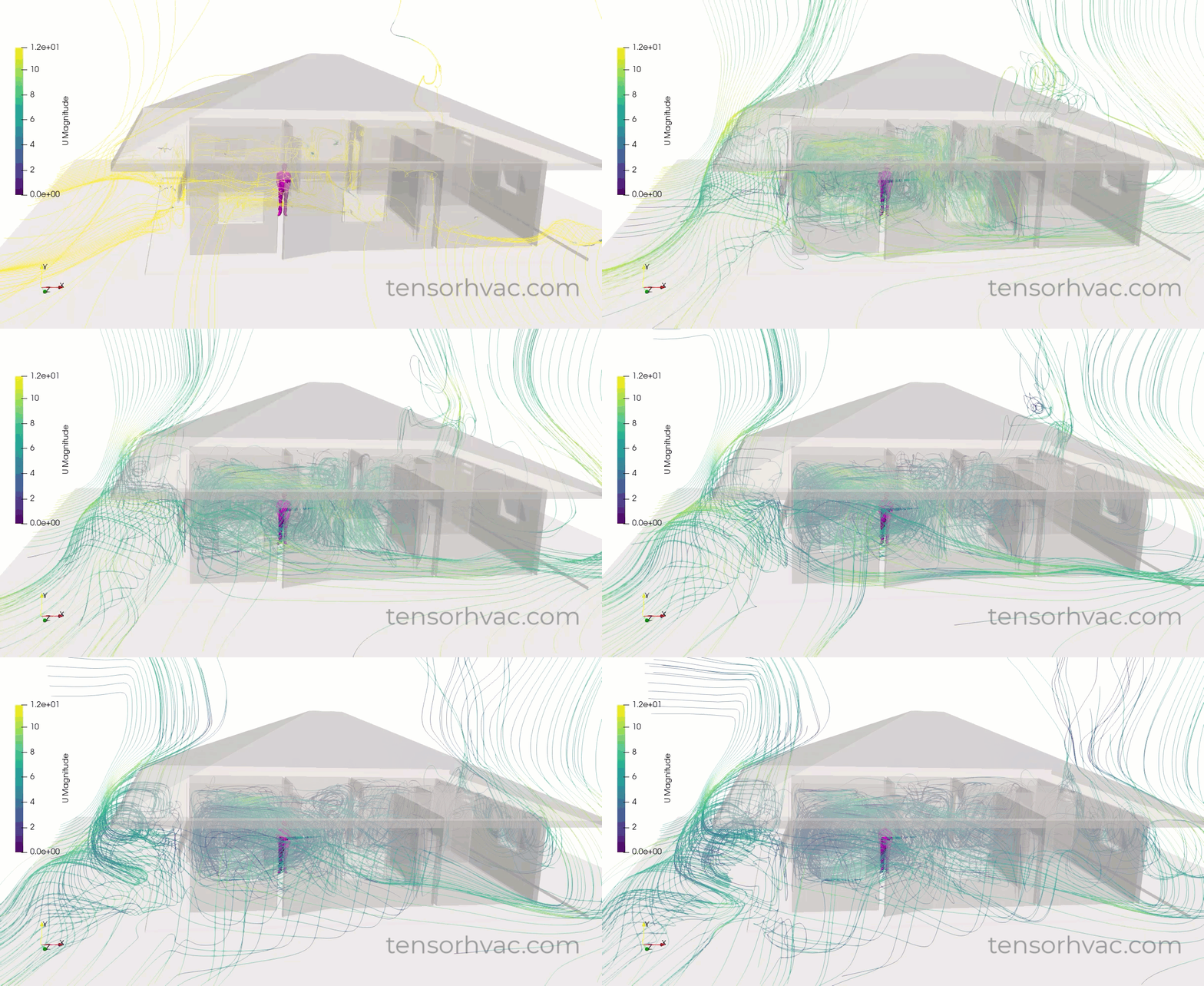
One of the most important applications of CFD in building aerodynamics is evaluating wind loads on structures. Strong winds exert pressure on building surfaces, which can influence structural stability and safety. Engineers use CFD simulations to predict pressure distribution across building facades, roofs, and corners. This information helps structural engineers design buildings that can withstand wind forces while ensuring safety and durability.
CFD is also widely used to analyze pedestrian wind comfort around buildings. Tall buildings and dense urban environments can create strong wind accelerations at ground level. When wind flows around a building, it may accelerate through narrow passages or create strong downdrafts that reach pedestrian areas. These high wind speeds can make outdoor spaces uncomfortable or even unsafe for pedestrians. CFD simulations allow engineers to identify areas where wind speeds may become excessive and modify building designs or landscaping features to improve pedestrian comfort.
Another important use of CFD in urban design is studying pollutant dispersion. In cities, pollutants from vehicles, industrial facilities, and other sources can accumulate in areas with poor airflow. CFD simulations help engineers understand how wind transports pollutants through urban environments and identify locations where air circulation is weak. This information can support urban planning decisions that improve air quality and public health.
Natural ventilation is another area where CFD simulations are valuable. Some buildings rely on wind-driven airflow to provide ventilation instead of mechanical HVAC systems. The effectiveness of natural ventilation depends on how wind interacts with building openings such as windows, vents, and atriums. CFD simulations allow engineers to evaluate how air enters and exits the building and determine whether natural ventilation strategies provide adequate airflow.
CFD also helps engineers understand turbulence and flow separation around buildings. When wind encounters sharp edges or corners, it often separates from the surface and forms large vortices in the wake region behind the building. These turbulent structures influence both wind loads and airflow patterns in surrounding areas. By analyzing these effects using CFD, engineers can modify building shapes or orientations to reduce undesirable wind behavior.
Open-source CFD software such as OpenFOAM is commonly used for simulating wind flow around buildings. OpenFOAM provides advanced turbulence modeling capabilities and flexible simulation tools that allow engineers to analyze complex urban airflow scenarios. Because OpenFOAM is open source, researchers and engineers can adapt models to study specific wind engineering problems, such as urban airflow, atmospheric boundary layers, or pollutant dispersion in cities.
Another advantage of CFD simulation is the ability to test multiple design scenarios before construction begins. Engineers can evaluate how changes in building height, shape, or orientation influence wind flow patterns. They can also analyze the effects of nearby buildings and urban layouts. This capability allows architects and planners to optimize building designs to improve airflow conditions and reduce potential wind-related problems.
Although CFD provides detailed insights into wind behavior, it is often used alongside wind tunnel experiments for validation. Wind tunnel testing provides physical measurements of aerodynamic forces and airflow patterns, while CFD simulations provide detailed visualization of the flow field. Together, these approaches give engineers a comprehensive understanding of wind effects on buildings.
Overall, CFD simulation has become a valuable tool in the design and analysis of buildings exposed to wind. By predicting airflow patterns, pressure distributions, turbulence, and pollutant transport, CFD helps engineers design buildings that are structurally safe, environmentally efficient, and comfortable for people living and working in urban environments. Tools such as OpenFOAM provide powerful capabilities for studying these complex wind interactions and supporting the development of better building designs in modern cities.
cfdcourse.com
Contact
wiratama@pttensor.com
+62-821-3868-4162
© 2026. All rights reserved.