
How CFD Helps Improve Heat Exchanger Performance
Blog post description.
ARTICLES
Wiratama
3/8/20263 min read
Heat exchangers are widely used in many industries to transfer heat between fluids efficiently. They play a critical role in power plants, chemical processing facilities, HVAC systems, refrigeration systems, and many other engineering applications. The performance of a heat exchanger depends on how effectively heat is transferred between the hot and cold fluids while maintaining acceptable pressure losses. Computational fluid dynamics (CFD) has become a powerful tool for analyzing and improving heat exchanger performance because it allows engineers to study detailed flow and temperature behavior inside these complex systems.
One of the main ways CFD helps improve heat exchanger performance is by providing detailed visualization of fluid flow inside the exchanger. In many heat exchanger designs, fluid flows through tubes, channels, or plates with complex geometries. These flow paths often produce turbulence, recirculation zones, and uneven velocity distributions. CFD simulations allow engineers to observe these flow patterns and identify regions where fluid movement is inefficient. By analyzing these areas, designers can modify geometry or flow paths to improve mixing and heat transfer.
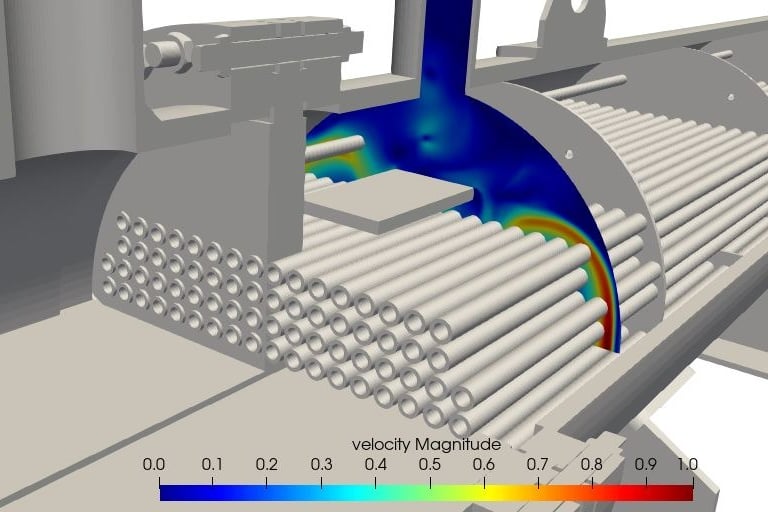
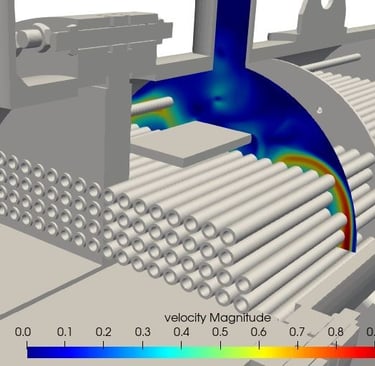
Another important advantage of CFD is its ability to predict temperature distribution throughout the heat exchanger. Heat transfer depends on the temperature difference between the hot and cold fluids and the efficiency of thermal energy transfer across the heat transfer surfaces. CFD simulations provide detailed temperature fields that show how heat moves through the fluid and the exchanger walls. This allows engineers to detect areas where heat transfer is weak or uneven and improve the design to achieve more uniform thermal performance.
CFD also helps engineers evaluate the effects of turbulence on heat transfer. Turbulent flow generally enhances heat transfer because it increases mixing between fluid layers. However, turbulence can also increase pressure losses within the system. Using CFD, engineers can study the balance between improved heat transfer and increased pressure drop. By optimizing flow conditions and geometry, engineers can achieve a design that maximizes heat transfer efficiency while minimizing energy losses due to pumping power.
Pressure drop analysis is another important aspect of heat exchanger design. While increasing turbulence may improve heat transfer, it can also increase the resistance to fluid flow. Excessive pressure losses require more pumping power, which increases operational energy costs. CFD simulations allow engineers to predict pressure distribution and identify locations where flow resistance is too high. Designers can then adjust channel spacing, tube arrangements, or surface features to reduce unnecessary pressure losses.
CFD simulations also enable engineers to test different design configurations before building physical prototypes. For example, engineers can compare various tube arrangements, fin geometries, or plate patterns within a heat exchanger. By running simulations for multiple designs, they can evaluate which configuration provides the best combination of heat transfer performance and flow efficiency. This approach reduces the need for expensive experimental prototypes and accelerates the design optimization process.
Another benefit of CFD is its ability to analyze operating conditions that may be difficult to reproduce experimentally. Engineers can simulate different flow rates, fluid properties, inlet temperatures, or environmental conditions to understand how the heat exchanger performs under a wide range of scenarios. This capability helps ensure that the final design remains reliable even when operating conditions change.
CFD can also be used to study fouling and flow distribution issues inside heat exchangers. Fouling occurs when deposits accumulate on heat transfer surfaces, reducing thermal efficiency over time. By simulating flow behavior and identifying areas where fluid velocity is low or recirculation occurs, engineers can predict where fouling is more likely to develop. Design modifications can then be implemented to reduce these problem areas and extend the operational life of the equipment.
In addition to improving efficiency, CFD simulations help engineers better understand the underlying physical processes inside heat exchangers. By analyzing velocity fields, temperature gradients, and pressure distributions, engineers gain insight into how fluid dynamics and heat transfer interact within the system. This deeper understanding allows designers to develop more innovative and efficient heat exchanger designs.
Overall, CFD has become an essential tool for improving heat exchanger performance. By providing detailed insight into flow behavior, heat transfer mechanisms, and pressure losses, CFD enables engineers to optimize designs, reduce energy consumption, and enhance system reliability. As computational power continues to increase, CFD simulations will play an even greater role in the development of high-performance heat exchangers for a wide range of industrial applications.
cfdcourse.com
Contact
wiratama@pttensor.com
+62-821-3868-4162
© 2026. All rights reserved.