
How CFD Helps Optimize Data Center Cooling
Blog post description.
ARTICLES
Wiratama
3/8/20263 min read
Data centers are critical infrastructure that support modern digital services, cloud computing, and large-scale data processing. These facilities contain thousands of servers and electronic components that generate a significant amount of heat during operation. Maintaining proper cooling is essential because excessive temperatures can reduce equipment performance, shorten hardware lifespan, and increase the risk of system failure. Designing an effective cooling strategy is therefore one of the most important aspects of data center engineering. Computational fluid dynamics (CFD) has become a powerful tool for optimizing data center cooling by allowing engineers to analyze airflow and temperature distribution before implementing physical changes.
CFD simulation allows engineers to model the internal layout of a data center, including server racks, cooling units, airflow paths, and structural elements. By solving the governing equations of fluid flow and heat transfer, CFD can predict how air moves through the facility and how heat generated by servers is transported and removed. This detailed analysis helps engineers understand whether cooling air is distributed efficiently or whether certain areas experience insufficient airflow.
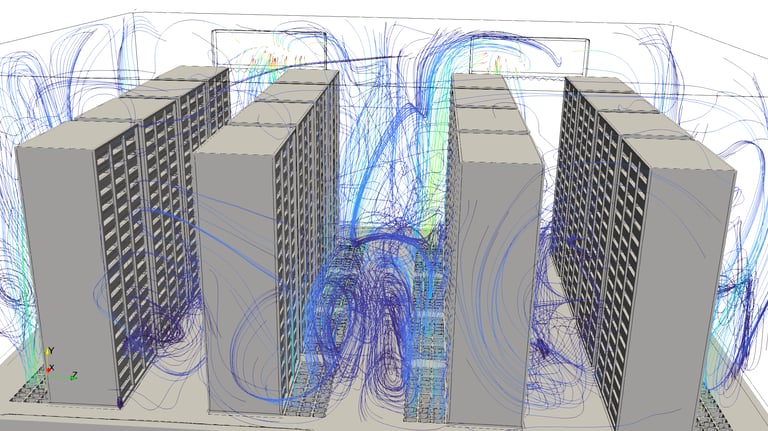
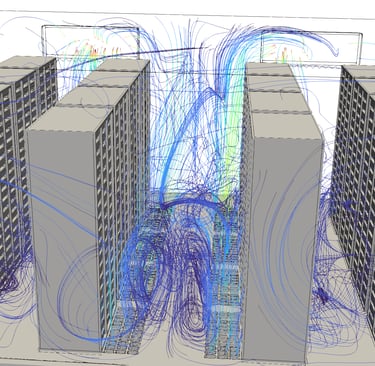
One of the main challenges in data center cooling is preventing the formation of hotspots. Hotspots occur when certain server racks receive inadequate cooling airflow, causing temperatures to rise above safe operating limits. CFD simulations allow engineers to identify these regions by visualizing temperature fields throughout the data center. By detecting hotspots early, designers can adjust rack arrangements, cooling unit placement, or airflow management strategies to ensure that all equipment receives sufficient cooling.
CFD also helps engineers analyze airflow management techniques commonly used in data centers. For example, many facilities use hot aisle and cold aisle configurations to separate incoming cool air from outgoing hot exhaust air. CFD simulations allow engineers to evaluate how effectively this arrangement prevents mixing between hot and cold air streams. If mixing occurs, cooling efficiency decreases and energy consumption increases. By studying airflow patterns, engineers can refine aisle layouts, containment systems, and airflow barriers to improve thermal management.
Another important application of CFD in data centers is optimizing the placement of cooling units. Cooling equipment such as computer room air conditioners or computer room air handlers must deliver cool air efficiently to server racks while removing heated air from the environment. CFD simulations allow engineers to test different equipment locations and airflow directions to determine which configurations provide the most uniform cooling performance.
CFD also plays an important role in improving energy efficiency. Cooling systems account for a large portion of a data center’s total energy consumption. Inefficient airflow distribution can cause cooling equipment to operate at higher capacity than necessary. CFD simulations allow engineers to evaluate airflow and temperature distribution under different operating conditions and identify opportunities to reduce energy usage while maintaining safe temperatures.
Another advantage of CFD is the ability to simulate changes in data center configuration before they are implemented physically. As computing demands increase, data centers frequently add new server racks or upgrade existing equipment. Each modification can alter airflow patterns and heat loads within the facility. CFD simulations allow engineers to predict how these changes will affect cooling performance and ensure that the ventilation system can accommodate new heat loads.
Open-source CFD tools such as OpenFOAM are increasingly used for analyzing airflow and thermal management in data centers. OpenFOAM provides flexible modeling capabilities that allow engineers to simulate complex airflow interactions, heat transfer processes, and ventilation strategies within large facilities. Because OpenFOAM is open source, engineers can customize models and perform large-scale simulations without licensing restrictions, making it well suited for advanced cooling analysis.
CFD simulations also support better planning and communication among engineering teams responsible for data center design. Visualization of airflow patterns and temperature distributions helps engineers, facility managers, and decision-makers understand how the cooling system behaves under different scenarios. This insight allows teams to make more informed decisions when designing or upgrading cooling infrastructure.
Although CFD is a powerful tool, it is typically used alongside real-world measurements and operational monitoring systems. Simulation results help guide design improvements, while sensors and monitoring systems provide real-time data during facility operation. Combining these approaches ensures that cooling systems perform reliably under actual operating conditions.
Overall, CFD has become an essential technology for optimizing data center cooling. By analyzing airflow behavior, identifying hotspots, improving airflow management strategies, and supporting energy-efficient design, CFD helps engineers create data centers that operate reliably while minimizing energy consumption. Tools such as OpenFOAM provide advanced simulation capabilities that allow engineers to study these complex thermal management challenges in detail and develop more efficient cooling solutions for modern data centers.
cfdcourse.com
Contact
wiratama@pttensor.com
+62-821-3868-4162
© 2026. All rights reserved.