
How CFD Improves Aerodynamics in Automotive Engineering
Blog post description.
ARTICLES
Wiratama
3/8/20263 min read
Aerodynamics plays a crucial role in automotive engineering because the way air flows around a vehicle directly affects fuel efficiency, stability, performance, and noise. When a vehicle moves at high speed, it must push air out of the way, and this interaction between the vehicle and the surrounding air creates aerodynamic forces such as drag and lift. Engineers must carefully design vehicle shapes to minimize unwanted aerodynamic effects while improving performance. Computational fluid dynamics (CFD) has become an essential tool for analyzing and improving vehicle aerodynamics during the design process.
CFD simulation allows engineers to study airflow around a vehicle in a virtual environment. By solving the governing equations of fluid motion, CFD models can predict velocity fields, pressure distributions, and turbulent flow structures around the vehicle body. This detailed information helps engineers understand how air interacts with different parts of the vehicle, including the front bumper, hood, windshield, roof, underbody, and rear surfaces.
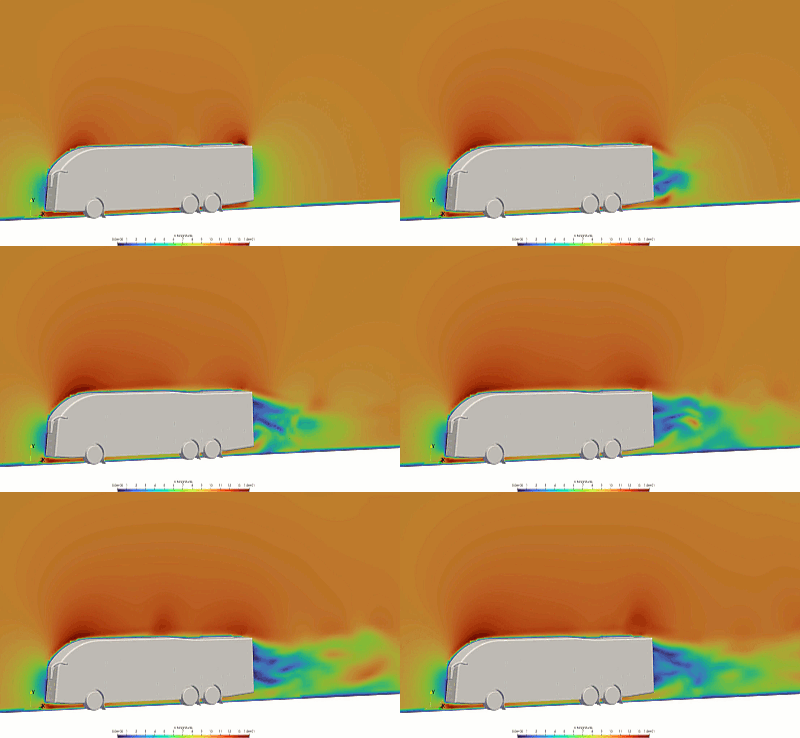
One of the most important aerodynamic factors in vehicle design is drag. Drag is the resistance force that opposes the motion of a vehicle through air. Higher drag forces require more engine power to maintain speed, which leads to increased fuel consumption. CFD simulations allow engineers to analyze the sources of drag around a vehicle and identify regions where airflow separates or forms large wake structures. By modifying the vehicle shape, engineers can reduce drag and improve overall energy efficiency.
CFD also helps engineers improve vehicle stability. As air flows around a moving vehicle, pressure differences can generate lift forces that reduce the normal force between the tires and the road surface. Excessive lift can reduce traction and negatively affect vehicle handling, especially at high speeds. CFD simulations allow engineers to analyze these aerodynamic forces and design features such as spoilers, diffusers, and underbody panels that help control airflow and improve vehicle stability.
Another important application of CFD in automotive engineering is analyzing airflow through cooling systems. Vehicles rely on airflow to cool components such as engines, radiators, brakes, and batteries. CFD simulations allow engineers to study how air enters through the front grille, moves through the engine compartment, and exits the vehicle. By optimizing these airflow paths, designers can improve cooling performance while minimizing aerodynamic drag.
CFD is also widely used to study underbody aerodynamics. The airflow beneath a vehicle can strongly influence overall drag and lift forces. Features such as flat underbody panels, diffusers, and aerodynamic covers can improve airflow under the vehicle and reduce turbulence. CFD simulations allow engineers to evaluate different underbody designs and determine which configurations provide the best aerodynamic performance.
Wind noise is another factor that automotive engineers must consider during vehicle design. Turbulent airflow around side mirrors, pillars, and window edges can generate aerodynamic noise that affects passenger comfort. CFD simulations allow engineers to study the turbulent structures responsible for noise generation and adjust design details to reduce these effects.
One of the major advantages of CFD in automotive design is the ability to test many design variations without building physical prototypes. Engineers can simulate multiple body shapes, aerodynamic devices, and airflow management strategies in a digital environment. This rapid evaluation of design alternatives allows engineers to optimize aerodynamics much earlier in the development process.
CFD simulations are often used together with wind tunnel testing to achieve the best results. While wind tunnels provide experimental validation, CFD offers detailed insight into the internal flow structures that are difficult to measure experimentally. The combination of simulation and experimental testing helps engineers develop vehicles that perform well under real-world conditions.
Open-source CFD tools such as OpenFOAM are increasingly used in automotive aerodynamics research and development. OpenFOAM provides engineers with the flexibility to simulate complex turbulent flows around vehicles and customize simulation models for specific aerodynamic studies. This flexibility makes it valuable for both academic research and industrial applications.
Overall, CFD has transformed the way aerodynamic design is performed in the automotive industry. By allowing engineers to visualize airflow, analyze aerodynamic forces, and evaluate design changes quickly, CFD helps improve fuel efficiency, vehicle stability, cooling performance, and passenger comfort. As computational power continues to increase, CFD simulations will play an even greater role in the development of future automotive technologies.
cfdcourse.com
Contact
wiratama@pttensor.com
+62-821-3868-4162
© 2026. All rights reserved.