
How CFD Improves Pump and Compressor Performance
Blog post description.
ARTICLES
Wiratama
3/8/20263 min read
Pumps and compressors are essential components in many industrial systems, including power plants, chemical processing facilities, water distribution networks, and oil and gas operations. Their performance directly affects system efficiency, reliability, and operating costs. Designing and optimizing these machines requires a detailed understanding of how fluids move through rotating components, channels, and internal passages. Computational fluid dynamics (CFD) has become an important tool for improving pump and compressor performance because it allows engineers to analyze internal flow behavior in ways that are difficult to observe experimentally.
One of the main ways CFD improves pump and compressor performance is by providing detailed insight into internal flow patterns. Inside these machines, fluids pass through complex geometries that include rotating blades, diffusers, volutes, and narrow flow passages. These features create complicated flow structures such as turbulence, separation, recirculation zones, and secondary flows. CFD simulations allow engineers to visualize velocity fields and flow direction throughout the entire machine. This detailed understanding helps designers identify areas where energy losses occur and modify the geometry to improve performance.
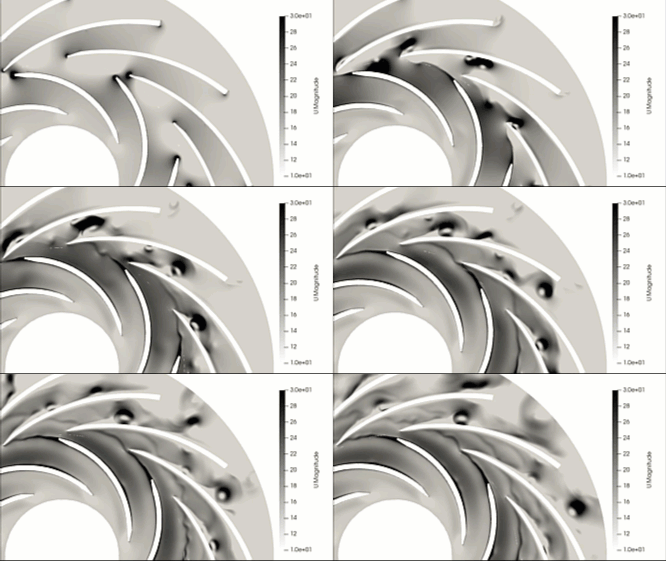
CFD is also valuable for analyzing pressure distribution within pumps and compressors. Pressure rise is a key measure of performance in these machines, and the pressure field inside the device determines how effectively the fluid gains energy. CFD simulations allow engineers to evaluate how pressure changes along the flow path, from the inlet through the impeller and into the discharge region. By studying these pressure variations, engineers can optimize blade shapes and flow passages to achieve higher pressure increases with lower energy losses.
Another important aspect of pump and compressor performance is efficiency. Energy losses inside rotating machinery can occur due to turbulence, friction, and flow separation. CFD simulations allow engineers to identify the sources of these losses and understand how they affect overall efficiency. For example, CFD can reveal whether flow separation occurs on the surfaces of impeller blades or whether vortices form in the volute region. Once these loss mechanisms are understood, designers can refine blade angles, channel geometry, or surface contours to reduce energy dissipation.
CFD also plays an important role in analyzing cavitation in pumps. Cavitation occurs when local pressure in the fluid drops below the vapor pressure, causing vapor bubbles to form and collapse. These bubble collapses can damage pump components and reduce performance. CFD simulations allow engineers to predict where low-pressure regions may occur and evaluate whether cavitation is likely under certain operating conditions. By adjusting design parameters or operating conditions, engineers can reduce the risk of cavitation and improve system reliability.
In compressors, CFD is often used to study complex aerodynamic behavior in rotating blade rows. Compressors used in gas turbines, refrigeration systems, and industrial processes involve highly three-dimensional flow patterns. CFD simulations help engineers understand how air or gas accelerates through blade passages, how shock waves form in high-speed compressors, and how flow interactions affect overall compression efficiency. These insights allow engineers to design blade geometries that improve aerodynamic performance and reduce losses.
Another advantage of CFD is its ability to evaluate different operating conditions without building multiple physical prototypes. Pumps and compressors often operate across a range of flow rates, pressures, and rotational speeds. CFD simulations allow engineers to analyze performance under these varying conditions and generate performance curves such as head-flow or pressure-flow relationships. This information helps engineers ensure that the machine performs efficiently across its entire operating range.
CFD simulations also assist in identifying flow instabilities that may affect the operation of pumps and compressors. Phenomena such as rotating stall, surge, and unsteady pressure fluctuations can reduce performance and potentially damage equipment. By studying these effects in simulations, engineers can identify conditions where instability might occur and develop designs that minimize these risks.
Another benefit of CFD is its role in reducing development time and cost. Traditional design methods often rely heavily on experimental testing and prototype development. While experimental testing remains important for validation, CFD allows engineers to evaluate many design alternatives virtually before constructing physical models. This reduces the number of prototypes required and accelerates the overall design process.
In modern engineering practice, CFD simulations are often combined with experimental measurements to achieve the best results. Experimental data helps validate simulation models, while CFD provides detailed insight into internal flow behavior that may be difficult to measure directly. Together, these methods allow engineers to design pumps and compressors that are more efficient, reliable, and optimized for specific operating conditions.
Overall, CFD has become an essential tool for improving the performance of pumps and compressors. By revealing detailed flow patterns, pressure distributions, energy losses, and potential instability mechanisms, CFD helps engineers design rotating machinery that operates more efficiently and reliably in a wide range of industrial applications.
cfdcourse.com
Contact
wiratama@pttensor.com
+62-821-3868-4162
© 2026. All rights reserved.