
How CFD Is Used in HVAC System Design
Blog post description.
ARTICLES
Wiratama
3/8/20263 min read
Heating, ventilation, and air conditioning systems are essential for maintaining comfortable and healthy indoor environments in residential buildings, commercial facilities, and industrial spaces. Designing an effective HVAC system requires a deep understanding of how air moves, how heat is transferred, and how temperature and airflow are distributed throughout a building. Computational fluid dynamics (CFD) has become an important tool in HVAC system design because it allows engineers to analyze airflow and temperature behavior in detail before construction or installation takes place.
One of the primary uses of CFD in HVAC design is analyzing airflow distribution within indoor spaces. In large buildings, air supplied by ventilation systems must be distributed evenly to maintain comfort and air quality. Poor airflow design can create regions where air circulation is weak, leading to stagnant zones, uneven temperature distribution, or poor ventilation. CFD simulations allow engineers to visualize airflow patterns throughout a room or building, helping them determine whether the ventilation system provides adequate air movement.
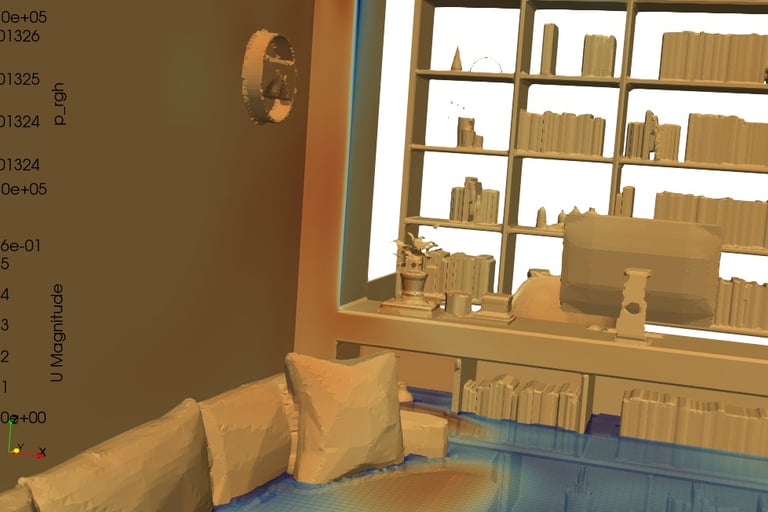
CFD also helps engineers evaluate temperature distribution inside buildings. HVAC systems are responsible for maintaining comfortable thermal conditions, but temperature variations can occur due to heat sources, solar radiation, equipment operation, or poor air mixing. Using CFD, engineers can simulate how heat spreads through indoor spaces and how conditioned air interacts with warmer or cooler regions. This analysis helps identify areas where temperatures may become too high or too low and allows designers to adjust airflow or system configuration accordingly.
Another important application of CFD in HVAC design is optimizing the placement of air supply and return vents. The position and orientation of vents strongly influence how air circulates within a room. Improper placement may cause short-circuiting, where supply air flows directly to return vents without effectively mixing with the room air. CFD simulations allow engineers to test different vent locations and airflow directions to ensure that fresh air is distributed evenly and that ventilation efficiency is maximized.
CFD is also useful for evaluating indoor air quality. Ventilation systems must remove contaminants such as dust, pollutants, and airborne particles while introducing clean air into occupied spaces. CFD simulations can model how contaminants move and disperse within a building. Engineers can use these results to design ventilation strategies that improve pollutant removal and maintain healthier indoor environments.
In facilities such as data centers, hospitals, laboratories, and manufacturing plants, thermal management is a critical concern. Large amounts of heat may be generated by equipment or industrial processes, and HVAC systems must remove this heat effectively to prevent overheating. CFD simulations help engineers study how heat produced by equipment interacts with cooling airflow. This allows designers to optimize cooling strategies, ensure that sensitive equipment operates within safe temperature limits, and prevent the formation of hotspots.
Another advantage of CFD in HVAC design is the ability to evaluate different operating conditions before a system is built. Engineers can simulate how the HVAC system performs under various scenarios, such as changes in occupancy, seasonal weather conditions, or varying heat loads. This predictive capability helps ensure that the system remains effective under different environmental conditions.
CFD also helps improve energy efficiency in HVAC systems. Heating and cooling account for a large portion of energy consumption in buildings. By optimizing airflow distribution, temperature control, and ventilation strategies, engineers can design systems that maintain comfort while using less energy. CFD simulations allow designers to identify inefficiencies and develop solutions that reduce energy usage without compromising indoor conditions.
Another important benefit of CFD is improved communication between engineers, architects, and building planners. Visualization of airflow and temperature patterns provides clear insight into how HVAC systems interact with building design. This information helps project teams make better decisions about building layout, duct routing, and ventilation strategies during the design stage.
CFD is typically used alongside traditional HVAC design methods rather than replacing them entirely. Engineers often combine simulation results with established design guidelines, experimental measurements, and engineering experience. This integrated approach allows designers to develop HVAC systems that are both efficient and reliable.
Overall, CFD has become an essential tool for modern HVAC system design. By allowing engineers to study airflow patterns, temperature distribution, ventilation efficiency, and contaminant transport, CFD helps ensure that buildings maintain comfortable indoor environments while minimizing energy consumption and operational costs.
cfdcourse.com
Contact
wiratama@pttensor.com
+62-821-3868-4162
© 2026. All rights reserved.