
How CFD Simulation Can Reduce Product Development Costs
Blog post description.
ARTICLES
Wiratama
3/8/20263 min read
Computational fluid dynamics simulation has become an essential tool in modern engineering because it allows engineers to analyze fluid flow and heat transfer without building physical prototypes. By simulating real-world conditions in a virtual environment, engineers can evaluate product performance early in the design process. This capability significantly reduces product development costs by minimizing expensive experiments, shortening development cycles, and improving design decisions before manufacturing begins.
One of the main ways CFD simulation reduces costs is by decreasing the number of physical prototypes required during product development. Traditionally, engineers had to build multiple prototypes and test them experimentally to evaluate performance. Each prototype required materials, manufacturing time, and laboratory testing, which could be expensive and time consuming. With CFD simulation, engineers can test many design variations digitally before committing to physical prototypes. As a result, only the most promising designs need to be manufactured and tested physically.
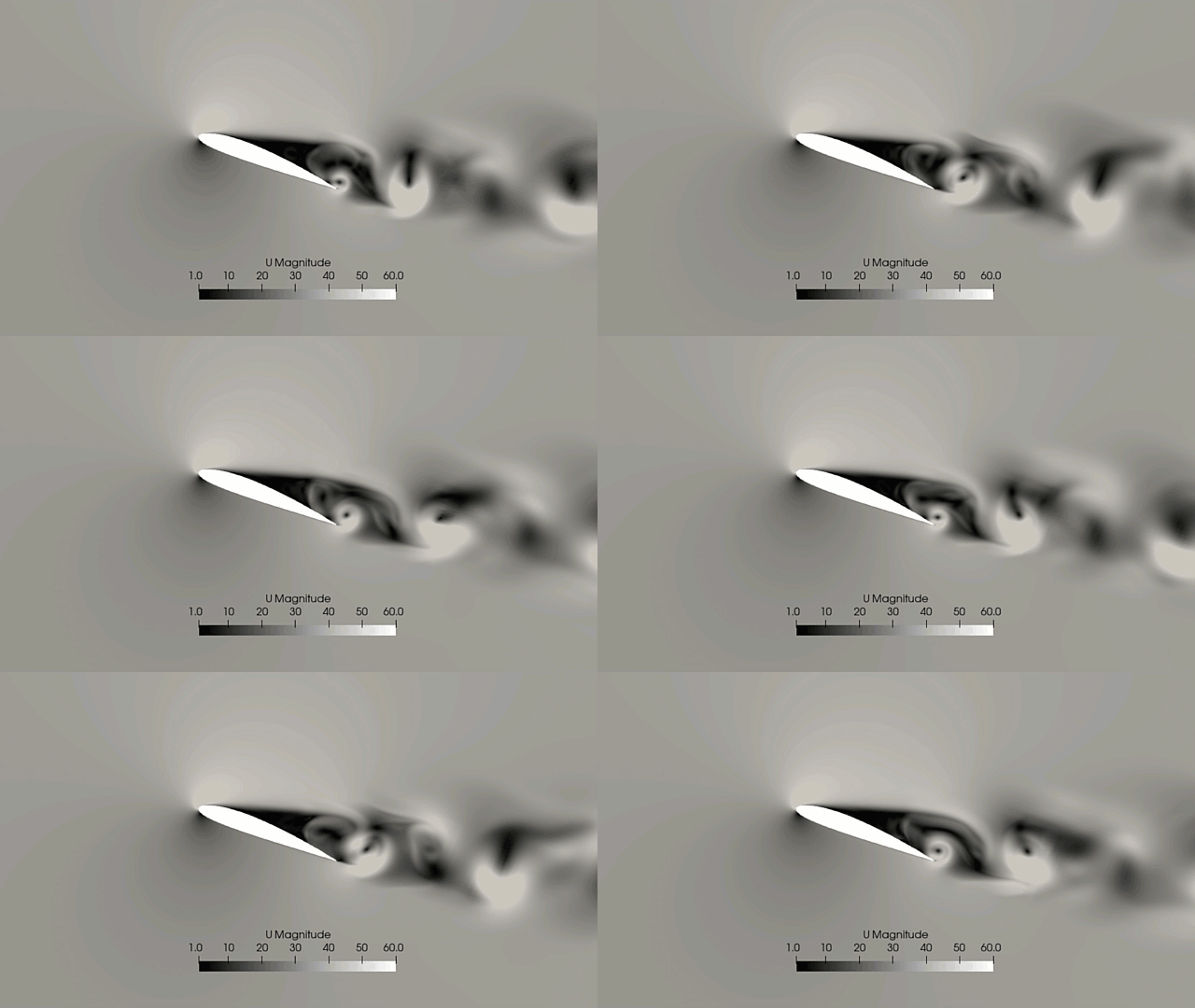
Another important benefit of CFD is the ability to identify design problems early in the development process. Fluid flow behavior often influences product performance in ways that are difficult to predict using simple calculations alone. For example, engineers designing pumps, heat exchangers, aircraft components, or ventilation systems must consider complex flow patterns, turbulence, and heat transfer. CFD simulations allow engineers to visualize velocity fields, pressure distributions, and temperature profiles, helping them detect potential issues before production begins. Detecting problems early prevents costly redesigns later in the project.
CFD simulation also accelerates the design optimization process. Engineers can easily modify parameters such as geometry dimensions, inlet conditions, material properties, or operating conditions within the simulation model. By performing multiple simulations with different design parameters, engineers can explore a wide design space and identify the most efficient configuration. This iterative process can be performed much faster in a digital environment than through physical experimentation.
In many industries, CFD simulations help reduce the time required to bring a product to market. Faster product development cycles provide a significant competitive advantage for companies. When engineers can analyze and refine designs quickly using simulations, they can shorten the time needed for testing and validation. This allows companies to launch products earlier and respond more quickly to market demands.
Another cost-saving aspect of CFD is the reduction of testing expenses. Experimental testing facilities such as wind tunnels, thermal chambers, or large-scale fluid testing systems can be very expensive to operate. While physical experiments are still necessary for final validation, CFD simulations can reduce the number of tests required. Engineers can use simulation results to narrow down design options before conducting expensive experimental tests.
CFD simulations also improve product efficiency, which can lead to long-term cost savings. For example, aerodynamic optimization can reduce drag on vehicles or aircraft, leading to improved fuel efficiency. In energy systems, CFD can help optimize combustion processes, heat transfer, or fluid transport, improving overall system performance. These improvements can significantly reduce operational costs over the lifetime of the product.
Another advantage of CFD is its ability to simulate extreme or difficult operating conditions that would be challenging to test experimentally. Engineers can analyze situations such as high temperatures, high pressures, or hazardous flow environments without risking equipment damage or safety hazards. This capability allows engineers to explore design limits and ensure reliability under demanding conditions.
CFD simulation also supports better communication between engineering teams. Visualization of flow patterns, temperature fields, and pressure distributions helps engineers explain design behavior more clearly to colleagues, managers, and stakeholders. This improved understanding can accelerate decision-making and reduce misunderstandings during product development.
In modern engineering practice, CFD simulation is rarely used as a complete replacement for experimental testing. Instead, it complements experimental methods by providing detailed insight into fluid behavior before prototypes are built. By combining simulation and testing, engineers can achieve more efficient and reliable product development processes.
Ultimately, the use of CFD simulation helps companies reduce development costs while improving product performance and innovation. By minimizing physical prototyping, identifying design problems early, accelerating optimization, and reducing testing expenses, CFD has become an indispensable tool for modern engineering design.
cfdcourse.com
Contact
wiratama@pttensor.com
+62-821-3868-4162
© 2026. All rights reserved.