
How Professionals Use OpenFOAM in Real Engineering Projects
Blog post description.
ARTICLES
Wiratama
3/7/20263 min read
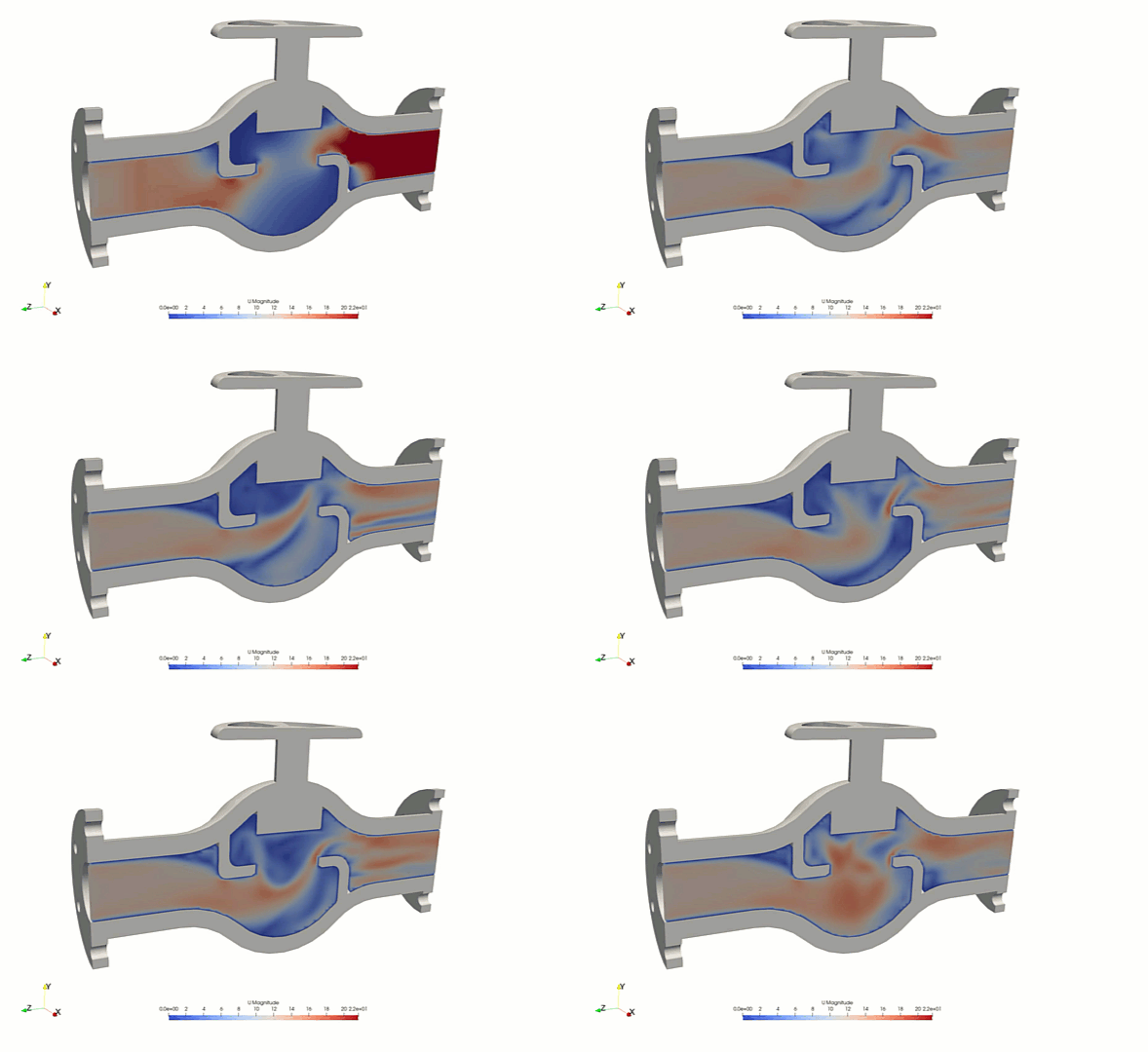
OpenFOAM is widely used in professional engineering environments to simulate complex fluid flow and heat transfer problems. Because it is open-source and highly customizable, it allows engineers to adapt simulation tools to very specific project requirements. Many industries use OpenFOAM not only for standard CFD analysis but also for developing custom solvers, optimizing designs, and studying complex physical phenomena that may be difficult to model using fixed commercial software workflows.
In aerospace engineering, OpenFOAM is frequently used to analyze aerodynamic performance. Engineers simulate airflow around aircraft wings, fuselages, drones, and rockets to evaluate lift, drag, and pressure distribution. These simulations help engineers optimize shapes to reduce aerodynamic resistance and improve fuel efficiency. OpenFOAM is also used to study shock waves, compressible flows, and high-speed aerodynamics, especially in research institutions and advanced aerospace projects.
In the automotive industry, engineers use OpenFOAM to study airflow around vehicles and inside engine compartments. External aerodynamic simulations help reduce drag and improve vehicle stability at high speeds. Engineers also analyze airflow through cooling systems, radiators, and ventilation ducts. By performing these simulations early in the design process, engineers can reduce the need for expensive wind tunnel experiments and physical prototypes.
Energy systems are another major application area for OpenFOAM. Engineers use CFD simulations to study the behavior of wind turbines, gas turbines, combustion chambers, and heat exchangers. In wind energy projects, OpenFOAM is used to simulate the interaction between rotating turbine blades and atmospheric wind conditions. These simulations help optimize blade design and improve overall energy efficiency.
OpenFOAM is also widely used in the oil and gas industry. Engineers analyze multiphase flows inside pipelines, separators, and processing equipment. Understanding how liquids and gases interact inside pipelines is important for maintaining safe and efficient transport of hydrocarbons. CFD simulations can help predict pressure drops, flow distribution, and the formation of undesirable flow patterns such as slugging.
In environmental engineering, OpenFOAM is used to simulate airflow and pollutant dispersion in urban environments. Engineers can model how pollutants spread through city streets, industrial zones, or near power plants. These simulations help evaluate air quality and support environmental planning decisions. OpenFOAM is also used in water engineering projects, such as simulating river flows, coastal currents, and flood scenarios.
Another important application area is HVAC system design. Engineers use OpenFOAM to simulate airflow, temperature distribution, and ventilation effectiveness inside buildings. These simulations help optimize air conditioning systems, improve thermal comfort, and ensure proper air circulation. In large facilities such as data centers, CFD simulations are used to analyze cooling performance and prevent overheating of electronic equipment.
In industrial manufacturing processes, OpenFOAM is used to study mixing, chemical reactions, and heat transfer in equipment such as reactors and mixing tanks. Engineers simulate how fluids move and interact within processing equipment to ensure efficient mixing and proper reaction conditions. These simulations help improve product quality and reduce operational costs.
One of the reasons professionals choose OpenFOAM for these applications is its flexibility. Because the source code is accessible, engineers can modify existing solvers or develop new models to represent specialized physical processes. This is particularly valuable in research and development environments where standard CFD models may not fully capture the complexity of a problem.
Another advantage of OpenFOAM is its ability to run on high-performance computing systems. Large engineering simulations often require millions or even billions of computational cells. OpenFOAM’s parallel processing capabilities allow engineers to distribute these simulations across clusters of processors, enabling the analysis of extremely complex systems.
In professional engineering projects, CFD simulations are rarely used alone. Instead, they are combined with experimental data, engineering design tools, and optimization methods. Engineers use OpenFOAM to test design variations, identify performance improvements, and understand physical mechanisms that are difficult to observe experimentally.
Ultimately, the value of OpenFOAM in real engineering projects comes from its ability to provide detailed insight into fluid behavior before physical prototypes are built. By predicting flow patterns, heat transfer, and pressure distributions, engineers can make better design decisions and reduce development costs. As computational power continues to grow and simulation methods become more advanced, tools like OpenFOAM are becoming an increasingly important part of modern engineering workflows.
cfdcourse.com
Contact
wiratama@pttensor.com
+62-821-3868-4162
© 2026. All rights reserved.