
OpenFOAM for Advanced Users: Why Researchers Prefer It
Blog post description.
ARTICLES
Wiratama
3/8/20263 min read
OpenFOAM has become one of the most widely used computational fluid dynamics platforms in academic research and advanced engineering studies. While beginners often find the software challenging because of its command-line interface and text-based configuration, experienced CFD users and researchers frequently prefer OpenFOAM because of its flexibility, transparency, and ability to be extended beyond standard simulation workflows. For advanced users, these characteristics make OpenFOAM a powerful environment for exploring new numerical methods and physical models.
One of the main reasons researchers prefer OpenFOAM is access to the source code. Unlike most commercial CFD software, OpenFOAM allows users to directly examine and modify the solver algorithms that govern fluid flow calculations. This access is extremely valuable for researchers developing new turbulence models, numerical schemes, or multiphase flow methods. Instead of treating the solver as a closed system, researchers can modify existing solvers or create entirely new ones to test theoretical ideas and experimental modeling approaches.
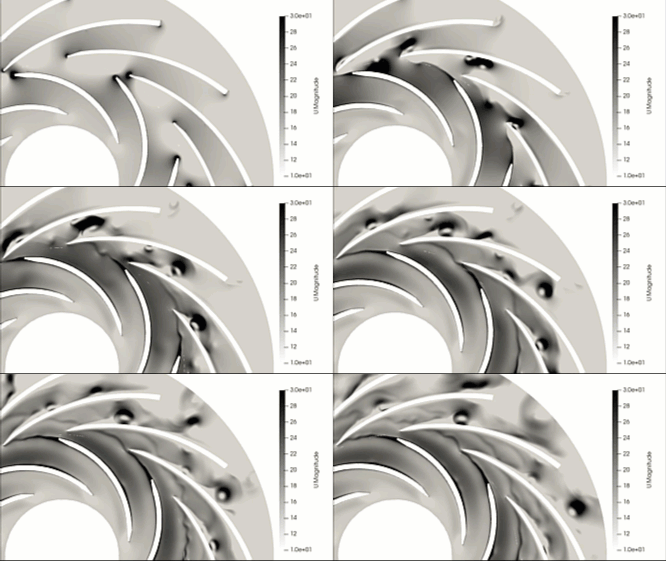
The modular architecture of OpenFOAM is another reason it is attractive to advanced users. The software is built as a collection of libraries that represent different physical models, numerical methods, and utilities. Researchers can combine these libraries in different ways to construct customized solvers for specific problems. For example, a researcher studying reactive flows may combine combustion models with turbulence models and custom chemical reaction mechanisms. This modular design allows the simulation framework to evolve alongside new research developments.
Another advantage of OpenFOAM in research environments is the ability to experiment with numerical discretization methods. CFD simulations depend heavily on how differential equations are discretized and solved. In commercial software, these numerical schemes are often fixed or limited to predefined options. OpenFOAM exposes many of these numerical settings directly to the user, allowing researchers to modify discretization schemes, solver algorithms, and convergence controls. This level of control is essential when studying the behavior of numerical methods or validating new computational approaches.
High-performance computing is also a major factor that attracts researchers to OpenFOAM. Many advanced CFD studies require extremely large simulations involving millions or even billions of computational cells. Because OpenFOAM does not impose licensing restrictions on processor usage, it can run efficiently on large computing clusters without additional software costs. This makes it particularly appealing for universities and research institutions that rely on shared supercomputing resources.
OpenFOAM is also well suited for integrating with other scientific computing tools. Researchers often combine CFD simulations with optimization algorithms, data analysis frameworks, or machine learning models. Because OpenFOAM operates through command-line tools and text-based configurations, it can be easily integrated into automated workflows using scripting languages such as Python or shell scripts. This capability allows researchers to perform parameter studies, automated optimization, and large batches of simulations without manual intervention.
Another reason researchers prefer OpenFOAM is the transparency of its physical models. When studying complex fluid phenomena, it is often necessary to understand exactly how equations are implemented in the solver. In closed commercial software, these details may not always be fully visible. OpenFOAM allows researchers to inspect the mathematical formulation of models directly in the source code. This transparency helps ensure that simulations are scientifically reproducible and allows researchers to verify how physical assumptions are implemented.
The open development ecosystem surrounding OpenFOAM also contributes to its popularity in research communities. Engineers and scientists from universities and research laboratories around the world contribute improvements, new models, and specialized solvers. This collaborative environment accelerates innovation and allows researchers to build on the work of others. As a result, OpenFOAM continuously evolves with new capabilities that reflect the latest developments in computational fluid dynamics.
In addition, many research publications and academic studies are built around OpenFOAM simulations. Because the software is open-source, other researchers can reproduce the computational methods used in a study by accessing the same solvers and modifying them if necessary. This reproducibility is an important principle in scientific research, and OpenFOAM supports it by making the entire simulation framework transparent and accessible.
Despite these advantages, using OpenFOAM effectively requires a deeper level of technical understanding than many commercial CFD packages. Researchers must be comfortable working with Linux environments, editing configuration dictionaries, and occasionally compiling modified solvers. However, for advanced users who want full control over the simulation process, these requirements are often viewed as advantages rather than obstacles.
For experienced CFD researchers, OpenFOAM is more than just a simulation tool. It is a flexible computational framework that allows engineers and scientists to explore new modeling approaches, test numerical theories, and perform large-scale simulations. This combination of flexibility, transparency, and scalability explains why OpenFOAM continues to be a preferred platform for advanced CFD research around the world.
cfdcourse.com
Contact
wiratama@pttensor.com
+62-821-3868-4162
© 2026. All rights reserved.