
OpenFOAM vs ANSYS Fluent: Which CFD Software Should Engineers Learn in 2025?
Blog post description.
ARTICLES
Wiratama
3/7/20263 min read
Choosing which CFD software to learn is a common question for engineers and students entering simulation fields. Two of the most widely discussed tools are OpenFOAM and ANSYS Fluent. Both are powerful CFD platforms used in academia and industry, but they differ significantly in workflow, accessibility, and learning strategy. Understanding these differences can help engineers decide which software is more valuable to learn in 2025.
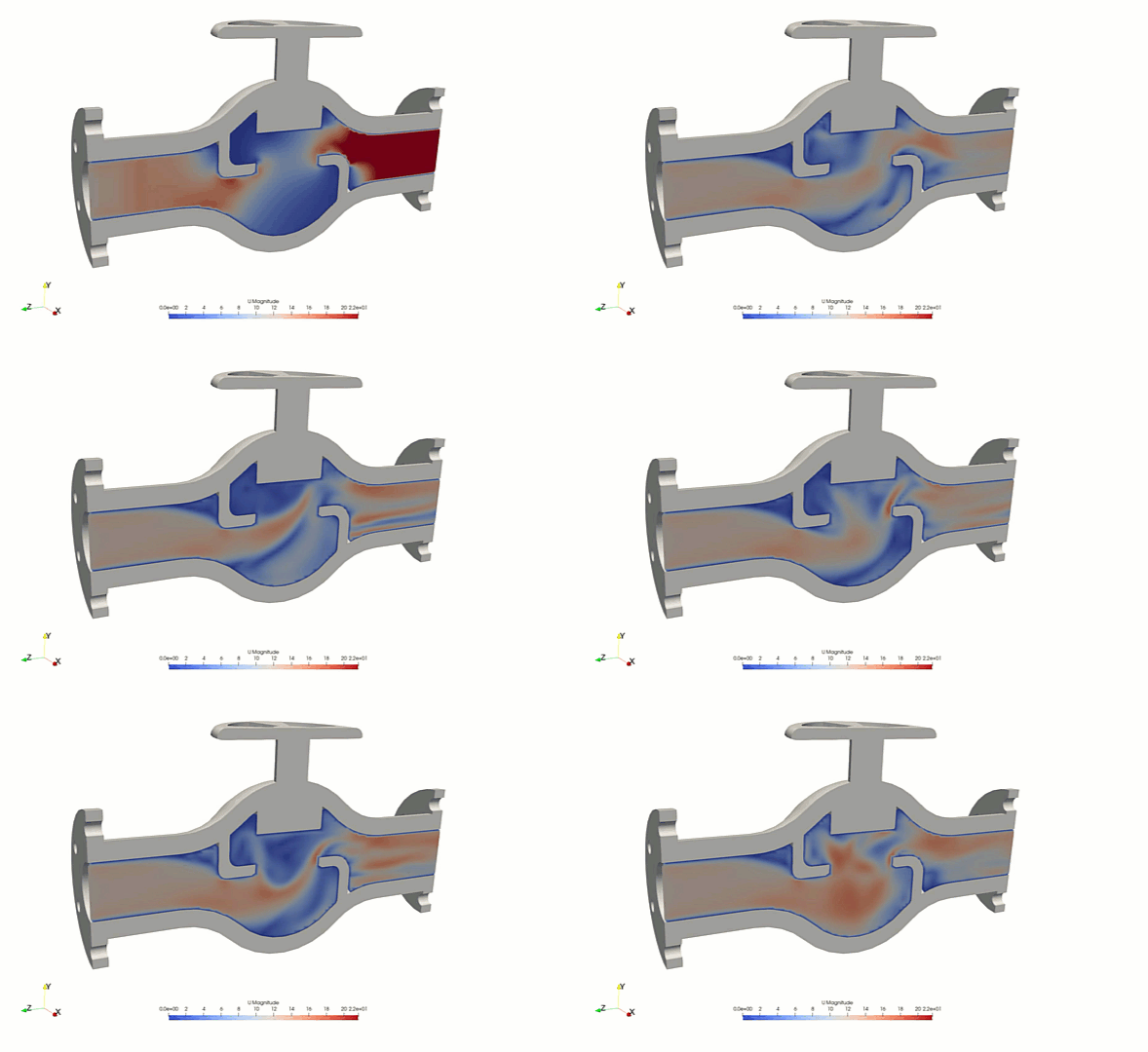
ANSYS Fluent is one of the most established commercial CFD tools and is widely used across industries such as aerospace, automotive, energy, and electronics cooling. It is known for its advanced physics modeling capabilities, validated algorithms, and robust simulation features. The software provides an integrated workflow where users can create geometry, generate meshes, define physics models, run simulations, and analyze results in a structured environment. Because of this integrated design, Fluent is often considered easier to learn for beginners compared with many open-source alternatives.
One of the biggest advantages of ANSYS Fluent is its graphical user interface. Engineers can configure simulations through menus and visual panels instead of manually editing configuration files. This makes the setup process faster and more intuitive, especially for engineers who are new to CFD. Fluent also offers extensive documentation, training resources, and professional technical support. As a result, many companies adopt Fluent as their primary CFD platform for production engineering tasks.
However, Fluent has an important limitation: cost. Commercial licenses can be expensive, which may restrict access for individuals, startups, or smaller research teams. While student versions exist, professional licenses often require significant annual fees. Because of this, many engineers and research groups look for open-source alternatives.
OpenFOAM is one of the most widely used open-source CFD platforms. Unlike commercial software, it provides full access to the source code, allowing users to modify solvers, create custom models, and automate simulation workflows. This level of flexibility is one of the main reasons OpenFOAM is popular in academic research and advanced engineering projects. Engineers can customize numerical algorithms and build specialized solvers for unique problems, which is something that is difficult or impossible in many commercial packages.
Another advantage of OpenFOAM is that it is completely free. Engineers can run large simulations on local computers or high-performance computing clusters without worrying about license limitations. This makes it especially attractive for researchers, universities, and companies that want full control over their simulation infrastructure.
Despite these strengths, OpenFOAM has a steeper learning curve. Most operations are performed through command-line tools and configuration dictionaries instead of graphical interfaces. Users must understand the case directory structure, solver configuration files, and numerical schemes before they can build reliable simulations. Because of this, beginners often find OpenFOAM more challenging to learn compared with Fluent.
In terms of simulation capability, both platforms are extremely powerful. Fluent often provides highly optimized algorithms and mature models that perform well for many industrial applications. OpenFOAM, on the other hand, offers unmatched flexibility for customization and research-oriented simulations. In some cases, OpenFOAM can even produce more specialized solutions because engineers can modify the underlying solver code.
For engineers deciding which CFD software to learn in 2025, the answer often depends on career goals. Engineers aiming for jobs in large engineering companies or consulting firms may benefit from learning ANSYS Fluent first because it is widely used in industry workflows. The software allows new users to become productive quickly and aligns with many commercial engineering environments.
On the other hand, engineers interested in research, advanced modeling, or developing custom simulation tools may find OpenFOAM more valuable. Learning OpenFOAM often leads to a deeper understanding of numerical methods and CFD algorithms because users interact directly with solver settings and source code.
In practice, many experienced CFD engineers eventually learn both tools. Fluent provides a fast and efficient environment for industrial simulations, while OpenFOAM offers the flexibility needed for research and custom solver development. Instead of viewing them as competitors, they can be seen as complementary tools within the broader CFD ecosystem.
For engineers planning their CFD career in 2025, the best strategy is often to start with one platform and later expand to the other. Building strong foundations in fluid mechanics, turbulence modeling, and numerical methods will ultimately matter more than the specific software used. Once those fundamentals are in place, both OpenFOAM and ANSYS Fluent become powerful tools for solving complex engineering problems.
cfdcourse.com
Contact
wiratama@pttensor.com
+62-821-3868-4162
© 2026. All rights reserved.