
Top Skills Mechanical Engineers Need in the CFD Industry
Blog post description.
ARTICLES
Wiratama
3/8/20263 min read
The computational fluid dynamics industry has become an important part of modern engineering practice. Many industries rely on CFD to analyze fluid flow, heat transfer, and aerodynamic performance before building physical prototypes. Mechanical engineers who want to work in the CFD field must develop a combination of theoretical knowledge, computational skills, and practical engineering understanding. These skills allow engineers to build accurate simulation models and interpret results effectively.
A strong foundation in fluid mechanics is one of the most important skills for any CFD engineer. CFD simulations are based on the governing equations of fluid flow, including conservation of mass, momentum, and energy. Mechanical engineers working in CFD must understand how these equations describe real physical systems. Knowledge of topics such as laminar and turbulent flow, boundary layers, compressible flow, and multiphase flow helps engineers choose appropriate models and interpret simulation results correctly.
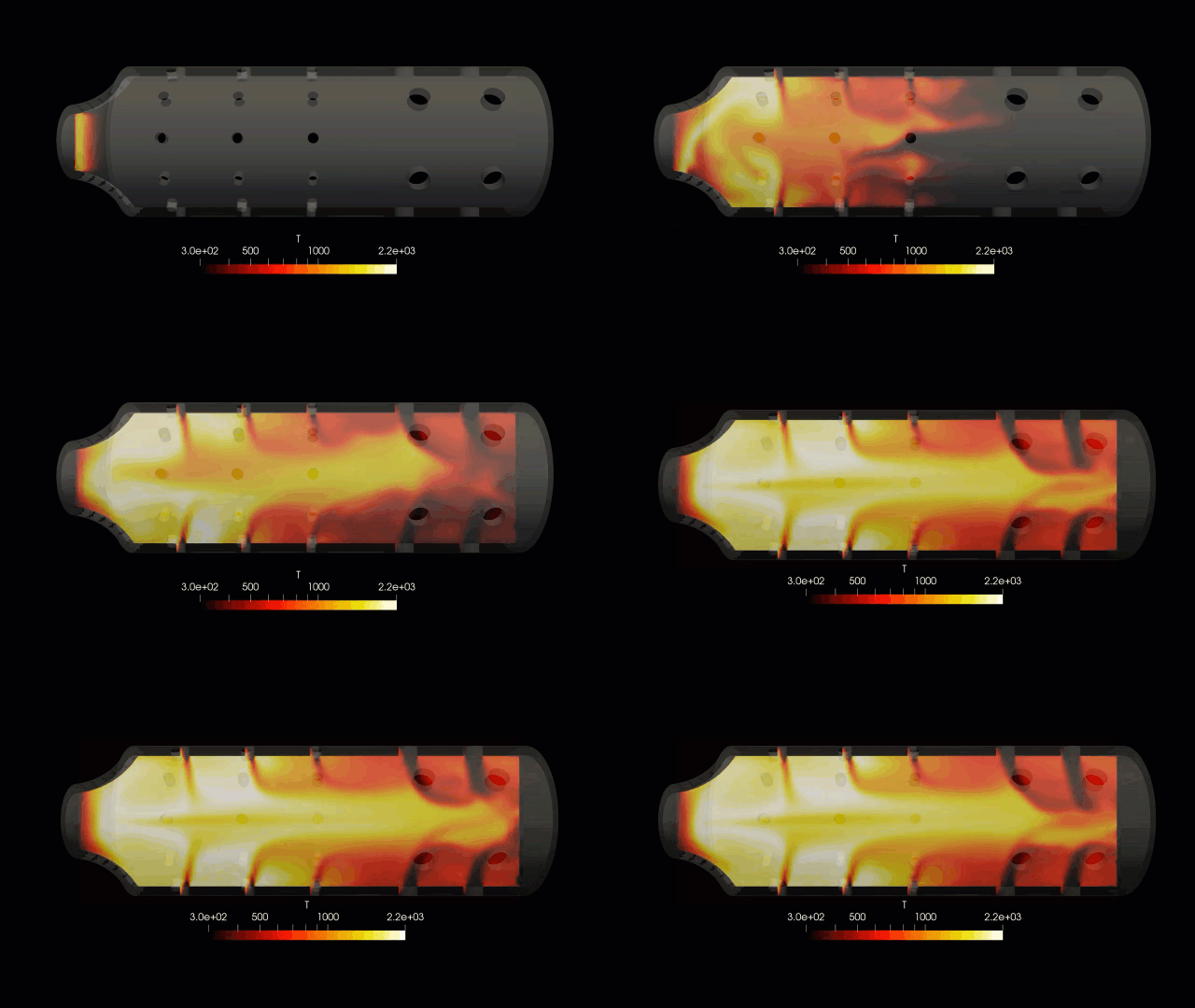
Understanding heat transfer is also essential in many CFD applications. Many engineering systems involve thermal processes, including cooling systems, heat exchangers, combustion chambers, and HVAC systems. Mechanical engineers working in CFD must understand conduction, convection, and radiation mechanisms to accurately simulate temperature behavior in fluid systems. This knowledge allows engineers to analyze thermal performance and design systems that maintain safe operating conditions.
Another important skill is knowledge of numerical methods. CFD relies on numerical techniques to solve complex differential equations that cannot be solved analytically. Mechanical engineers should understand concepts such as discretization, finite volume methods, numerical stability, convergence behavior, and error analysis. These concepts help engineers understand how simulation results are produced and how numerical settings influence solution accuracy.
Experience with CFD software is also a key skill for engineers entering the CFD industry. Many engineers work with commercial software such as ANSYS Fluent, STAR-CCM+, or COMSOL, while others use open-source tools such as OpenFOAM. Familiarity with at least one major CFD platform allows engineers to set up simulations, generate meshes, apply boundary conditions, and analyze results. Learning tools like OpenFOAM can also help engineers develop a deeper understanding of how CFD solvers operate internally.
Mesh generation and grid quality control are also important skills for CFD engineers. The mesh divides the simulation domain into small computational cells where equations are solved. The quality of the mesh directly affects simulation accuracy and stability. Engineers must understand how to generate meshes that capture important flow features while maintaining reasonable computational cost. Skills in structured and unstructured meshing, mesh refinement, and grid independence analysis are essential for producing reliable CFD results.
Programming and scripting skills are becoming increasingly valuable in the CFD industry. Engineers often use programming languages such as Python, MATLAB, or C++ to automate simulation workflows, process simulation data, or develop custom numerical models. In tools such as OpenFOAM, programming knowledge can also be used to modify solvers or implement new physical models. These skills allow engineers to build more advanced simulation tools and improve productivity.
Data analysis and visualization skills are also important for CFD engineers. CFD simulations generate large amounts of numerical data that must be interpreted carefully. Engineers must be able to analyze velocity fields, pressure distributions, temperature gradients, and turbulence structures to understand the behavior of the simulated system. Visualization tools such as ParaView help engineers transform simulation data into meaningful insights that guide engineering decisions.
Another key skill in the CFD industry is problem-solving ability. CFD simulations often involve complex physical phenomena and challenging numerical issues. Engineers must be able to diagnose problems such as divergence, poor convergence, or unrealistic flow behavior. This requires analytical thinking, patience, and a strong understanding of both physics and numerical methods.
Communication skills are also important for CFD engineers. Simulation results must often be explained to other engineers, managers, or project stakeholders who may not be familiar with CFD concepts. Engineers must be able to present simulation findings clearly and explain how these results influence design decisions. Effective communication helps ensure that CFD analysis contributes meaningfully to engineering projects.
Finally, curiosity and continuous learning are essential qualities for engineers working in the CFD field. CFD technology continues to evolve as computational power increases and new modeling techniques are developed. Engineers who stay updated with new methods, software tools, and research developments will be better prepared to solve complex engineering problems.
Overall, mechanical engineers entering the CFD industry must combine strong theoretical knowledge with practical computational skills. Understanding fluid mechanics, heat transfer, numerical methods, CFD software, programming, and data analysis allows engineers to perform accurate simulations and contribute to advanced engineering design. These skills help engineers use CFD effectively to solve real-world problems across many industries.
cfdcourse.com
Contact
wiratama@pttensor.com
+62-821-3868-4162
© 2026. All rights reserved.