
Why Mechanical Engineering Students Should Learn OpenFOAM
Blog post description.
ARTICLES
Wiratama
3/8/20263 min read
Mechanical engineering students today are entering a world where simulation plays an increasingly important role in engineering design and analysis. Modern industries rely heavily on computational tools to predict how systems behave before building physical prototypes. Computational fluid dynamics (CFD) is one of the most important areas of simulation because many engineering problems involve fluid flow, heat transfer, and aerodynamic behavior. Learning OpenFOAM can provide mechanical engineering students with valuable skills that prepare them for modern engineering challenges.
OpenFOAM is an open-source CFD platform that allows users to simulate fluid flow, heat transfer, and other physical processes using numerical methods. Unlike many commercial simulation tools, OpenFOAM provides full access to the solver structure and numerical models used in simulations. This transparency makes it a powerful educational tool because students can explore not only how simulations are performed but also how the underlying numerical methods work.
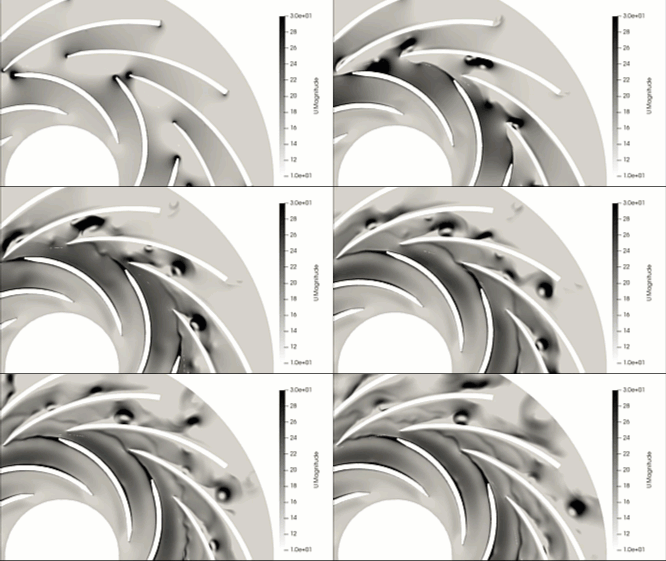
One of the main reasons mechanical engineering students should learn OpenFOAM is that it helps them develop a deeper understanding of fluid mechanics and numerical modeling. When students run simulations using OpenFOAM, they interact directly with governing equations, boundary conditions, and discretization schemes. This process encourages them to think carefully about how physical models are represented mathematically. Instead of treating simulation software as a black box, students learn how CFD methods actually operate.
Another important advantage of OpenFOAM is its accessibility. Because it is open-source software, students can download and use it without the licensing restrictions associated with many commercial CFD packages. This allows students to practice CFD simulations on their own computers and explore complex problems beyond classroom exercises. Open access to the software encourages experimentation and independent learning.
OpenFOAM also provides valuable experience with modern engineering workflows. Many engineering simulations require working in Linux environments, managing computational files, and running simulations using command-line tools. By learning OpenFOAM, students become familiar with these workflows and develop technical skills that are useful in research and industry environments. These skills include scripting, automation, and managing large simulation datasets.
Another reason students benefit from learning OpenFOAM is its strong presence in academic research. Many universities and research institutions use OpenFOAM for advanced CFD studies involving turbulence modeling, multiphase flows, combustion, and environmental fluid dynamics. Students who are already familiar with OpenFOAM can more easily participate in research projects and graduate-level studies involving computational modeling.
OpenFOAM also introduces students to high-performance computing concepts. Many CFD simulations require significant computational resources and are run on parallel computing systems. OpenFOAM allows users to perform parallel simulations without licensing limitations, making it suitable for large computational studies. Learning how to run simulations on multiple processors helps students understand how large-scale engineering simulations are performed in professional environments.
In addition, OpenFOAM exposes students to a wide range of real-world engineering applications. CFD simulations are used in industries such as aerospace, automotive engineering, energy systems, chemical processing, HVAC design, and renewable energy. By learning OpenFOAM, students gain experience analyzing practical engineering problems such as airflow around vehicles, heat transfer in cooling systems, or fluid mixing in industrial equipment.
Learning OpenFOAM also encourages problem-solving and analytical thinking. CFD simulations rarely work perfectly on the first attempt. Students must learn how to interpret solver output, analyze convergence behavior, and adjust simulation parameters to obtain reliable results. These troubleshooting skills are valuable for developing strong engineering intuition and technical confidence.
Another benefit of OpenFOAM is the large global community of engineers and researchers who use the software. Online forums, research publications, and open-source development projects provide extensive resources for learning and collaboration. Students can explore example cases, study research papers, and interact with other users who are solving similar engineering problems.
While learning OpenFOAM may initially appear challenging due to its command-line interface and detailed configuration structure, the skills gained from using it are extremely valuable. Students who become comfortable with OpenFOAM often develop a deeper understanding of CFD principles and gain experience with advanced simulation workflows that are widely used in engineering research and development.
Ultimately, mechanical engineering students who learn OpenFOAM gain a powerful tool for analyzing complex fluid and thermal systems. More importantly, they develop the computational thinking and numerical modeling skills that are increasingly important in modern engineering practice. As simulation continues to play a central role in product design and scientific research, familiarity with tools such as OpenFOAM can provide students with a significant advantage in their future careers.
cfdcourse.com
Contact
wiratama@pttensor.com
+62-821-3868-4162
© 2026. All rights reserved.